A little after mid-morning on October 8, 1980, the 82-foot cutter Point Francis departed Base Miami Beach, Florida, and began a 70 nautical mile run to the south toward Cay Sal Bank. Although Point Francis normally operated out of Sandy Hook, New Jersey, the 82-footer had been temporarily deployed to assist the Coast Guard’s interdiction of drug smuggling into South Florida.
By then, the Coast Guard had been waging a campaign against the maritime smuggling of illegal drugs for the previous 7½ years, seizing 362 vessels and more than 7.8 million pounds of marijuana through September 1980. Miraculously, in not one of those cases did the Coast Guard need to use disabling fire to stop a smuggler. That was about to change.
Nightfall saw Point Francis on the prowl to the north of Cay Sal Bank, ideally placed to monitor traffic coming up the Santaren Channel to the east, and the Florida Strait to the west. At about 8:00 p.m., amid cloudy skies and eight-foot seas pushed by 17-knot winds, the cutter detected a contact about ten nautical miles north of Dog Rocks. The contact was heading roughly West/Northwest toward south Florida at a speed of 10 to 12 knots.
.jpg?ver=rLBxQBqMSx5wlmm7OlFgvg%3d%3d "The 82-foot patrol boat (WPB) Point Francis underway. (DVIDS)")
Point Francis immediately extinguished its side lights and maneuvered to fall in behind the vessel under cover of darkness. About a half hour later, having used a night vision scope, Point Francis identified the contact as the U.S.-flagged 50-foot lobster boat Thomas E, with a homeport of Norfolk, Virginia. The cutter re-energized its running lights, activated its flashing blue law enforcement light and siren, and used both FM radio and loudspeaker to direct the vessel to heave to for boarding.
Instead of stopping, the Thomas E doused its own lights and abruptly changed course to the south—apparently trying to run for the safety of nearby Bahamian waters. Point Francis turned in pursuit, and with its top speed of nearly 30 knots, had no trouble staying with the fleeing vessel.
Now the cutter’s commanding officer was certain the fishing vessel was smuggling contraband. Lieutenant junior grade Kim Kryzwicki, commanding officer of the cutter, first tried using a fire hose to flood the lobster boat’s pilot house, then fired several bursts of .50 caliber machine gun fire across its bow in warning, and finally made three attempts to foul the boat’s propeller by passing a line across its bow. None of the actions worked.
The Coast Guard had sought and quickly received permission from the Government of The Bahamas to pursue the Thomas E into their territorial sea and take appropriate law enforcement action. However, the suspect vessel stayed in international waters by continuing back into the Santaren Channel, east of Cay Sal Bank, and then headed south.
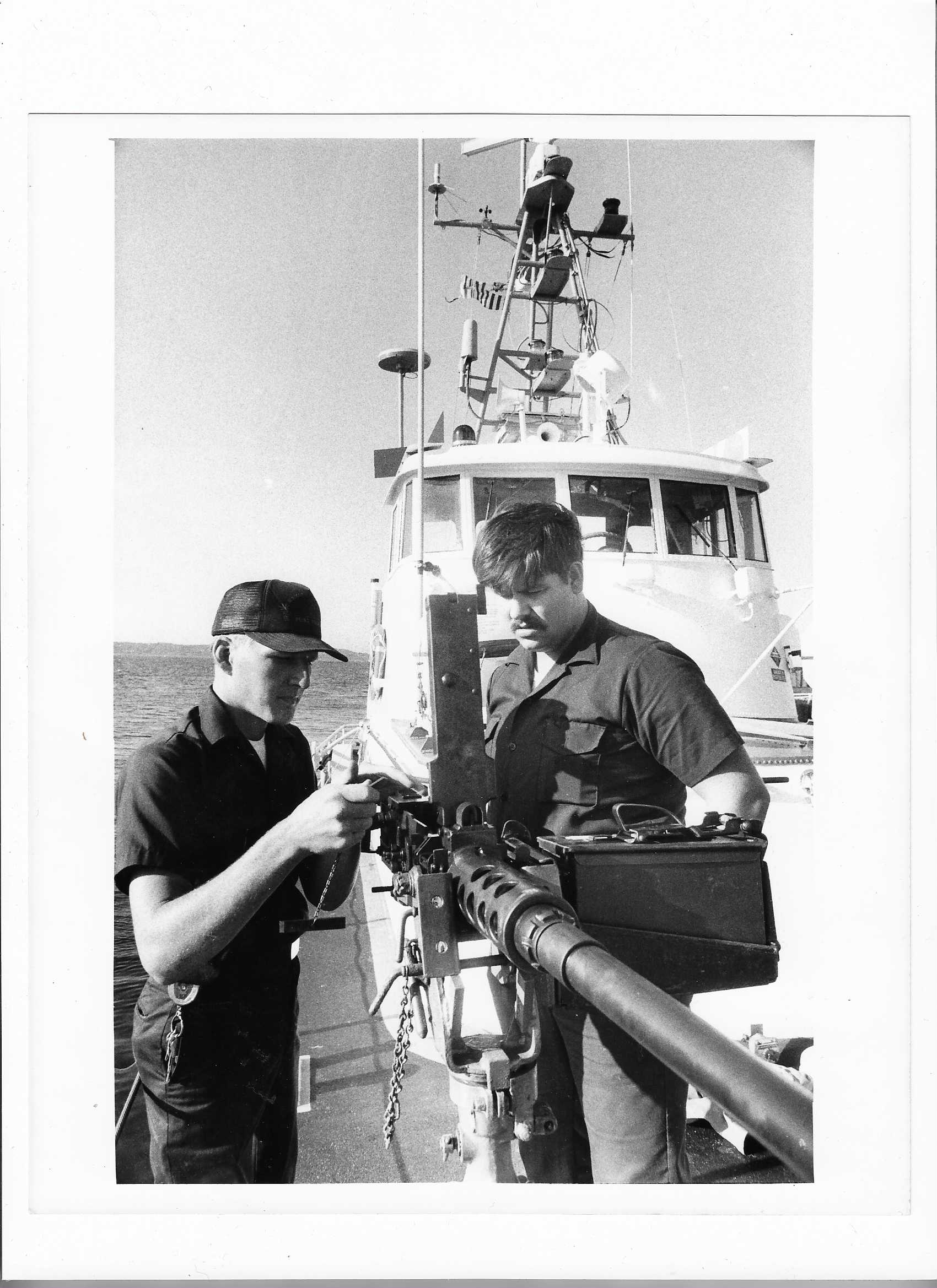
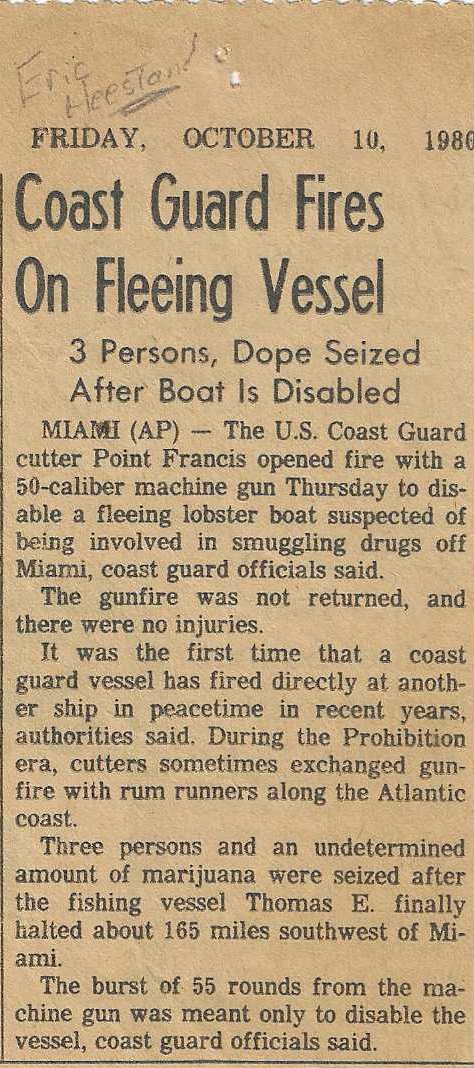
At 6:02 a.m. on October 9th, the Thomas E showed no inclination to stop and approached the entrance to the Old Bahama Channel. Point Francis again opened fire with a .50 caliber machine gun. This time, however, rather than firing only across the bow in warning, rounds were walked back into the vessel’s forward hull, at the waterline. When the fishing vessel still refused his order to heave to, Lt. Kryzwicki ordered his gunner to fire into the vessel’s stern. Black smoke soon began to rise from the vessel’s exhaust, and a person emerged on deck waving a white flag of surrender. Fifty-five rounds of ammunition had been expended.
A three-person boarding party quickly crossed via small boat from the cutter to Thomas E. The boarding party promptly discovered more than 27,000 pounds of marijuana bales stored in the vessel’s engine room. The three people onboard, including Vincent Stuart, Amador Ortega, and Armando Arias (all from Miami), were then arrested and the vessel seized. Following the prisoners’ transfer to Point Francis, the cutter’s crew began pumping out the seawater that had flooded the vessel’s engine room, and staunching the leak of ten gallons per minute that continued to pour in. After repairs were made, Thomas E’s propulsion was restarted, and both lobster boat and cutter headed for Base Miami Beach.
However, Thomas E ran out of fuel an hour and a half later and had to be taken in tow. This slowed the two vessels’ arrival at Miami until after 8:00 a.m. the next morning. Once moored at Base Miami Beach, U.S. Customs took custody of the boat and the drugs, and DEA took custody of the prisoners.
The prosecution of the smugglers was simplified by the passage of a new law during the previous month. In the past, the U.S. had to prove conspiracy to bring a controlled substance into the U.S.; the new law made it illegal for any U.S. person, or any person on a U.S. vessel or a vessel subject to U.S. jurisdiction on the high seas, to possess a controlled substance with intent to distribute. The crew of Thomas E met all criteria and could hardly argue that the 27 tons found on board their vessel were for personal use.
This case was also significant in that it was the first time since shortly after Prohibition ended, 47 years earlier, that the Coast Guard had to resort to disabling fire to stop a fleeing smuggler. Although several other cutters used disabling fire over the next few months, most smugglers quickly learned consequence of ignoring an order to “heave to.” Forty-five years later, even the most desperate smugglers know that continuing to flee will prompt disabling gunfire into their hulls and engines.
-USCG-