"The recommendation to abolish the Revenue-Cutter Service made to you by the Commission on Economy and Efficiency came out of a clear sky. No one connected with the service or with the Treasury Department, with which the service has been connected from the beginning in 1790, knew that the project was being considered. And it never had been considered before."
Letter from Treas. Sec. Franklin MacVeagh to President William Taft, February 26, 1912
The first major reorganization of the Coast Guard began 150 years ago as part of the American Progressive Movement. This movement was, in part, an effort to reform American institutions long tainted by patronage, corruption and inefficiency. The result of industrialization and mechanization, Progressivism reformed organizations and work culture based on efficiency, professionalization and training, merit-based promotion and systematic organization. For the Coast Guard the process began slowly but nearly resulted in the service’s elimination before it was reborn into the modern military agency we know today.
Congress founded the Coast Guard’s first predecessor agency, the U.S. Revenue Cutter Service, in 1790 at the insistence of first Treasury Secretary Alexander Hamilton. Hamilton started this civilian maritime law enforcement service with a fleet of ten sailing cutters, each one allocated to an East Coast seaport. Politically appointed customs collectors and cutter captains oversaw revenue cutter operations, and the collectors received their orders from the Secretary of Treasury. Congress tasked the cutters with maritime law enforcement and smuggling interdiction. However, 1790 would not be the Coast Guard’s only founding.
The second federal service to form the modern Coast Guard was the U.S. Lifesaving Service. In the beginning, the civilian-operated agency thrived under the leadership of General Superintendent Sumner I. Kimball. In 1871, Kimball became the first and only civilian chief of the Revenue Cutter Service when he was appointed head of the “Revenue Marine Bureau,” which also included the nascent Lifesaving Service. He diminished cutter control by politically appointed customs collectors through Progressive-style reforms. These included physical fitness reports and examinations for prospective officers and a system of merit-based officer promotion. And, in 1877, he established the School of Instruction (later the Coast Guard Academy) on board a training ship for cadets.
In 1878, with a growing network of lifesaving stations, Congress organized the U.S. Lifesaving Service and the Revenue Cutter Service as separate agencies under the Treasury Department. Kimball was chosen as the superintendent of the new service, and he continued to reform of the Lifesaving Service as its head. During his tenure, Kimball developed a nationwide system of 12 districts to administer the service’s boat stations, which had grown to 280 by 1915. Kimball’s reforms of the Revenue Cutter Service and Lifesaving Service preceded by a decade of Progressive federal government reforms, such as the 1883 Civil Service Reform Act.
Meanwhile, as the U.S. expanded from the East Coast to the Gulf Coast and on to the West Coast, revenue cutters populated regional seaports. By 1867, cutters were cruising Alaskan waters, and the Spanish-American War sent them as far away as the Southwest Pacific. With the annexation of Hawaii in 1898, cutters began regular patrols in the Pacific. This territorial growth led to more missions, including early living marine resources enforcement and humanitarian response. After its first 100 years of existence, the Revenue Cutter Service had evolved into a large agency with multiple missions, a global reach, sizable fleet and large workforce.
Progressive measures to cut costs, eliminate redundancy and increase efficiency in government, began under President Theodore Roosevelt, Jr. This trend continued into the administration of Roosevelt’s successor William H. Taft. In 1910, President Taft’s “Commission on Economy and Efficiency” began studying more efficient and cost-effective ways to organize the federal government, particularly the Executive Branch. By 1912, the commission circulated its report that recommended combining the U.S. Life-Saving Service with the U.S. Lighthouse Service. The report also proposed abolishing the Revenue Cutter Service and disbursing its ships and missions to other federal agencies.
.jpg?ver=9lyiVDwTOu_EjgnVoWExtw%3d%3d "Painting of President Woodrow Wilson from the White House collection. (White House)")
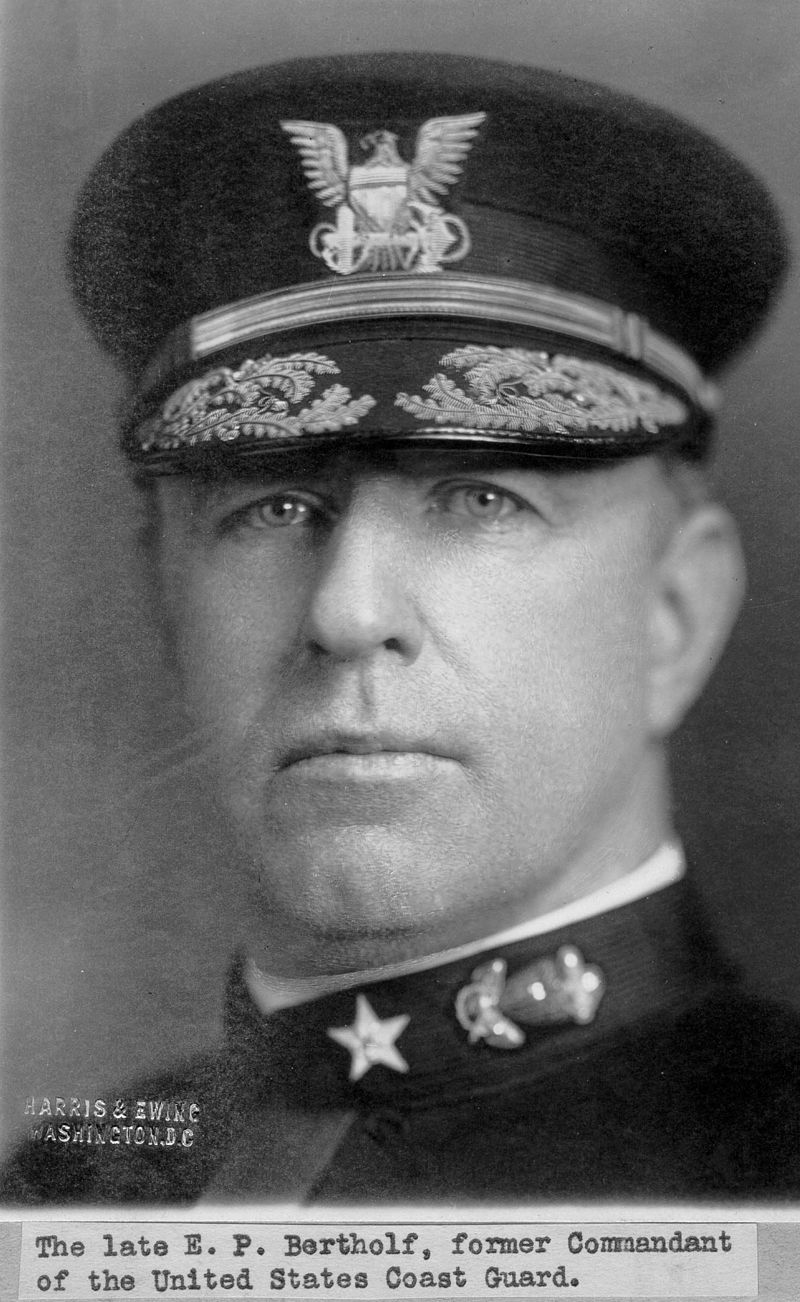
The commission’s recommendation was strongly opposed by Kimball, Treasury Secretary Franklin MacVeagh, and the Revenue Cutter Service’s “Captain Commandant,” Ellsworth P. Bertholf. In response to the commission’s proposals, Kimball and Bertholf devised a plan to merge the Lifesaving Service with the Revenue Cutter Service. This amalgamation would bring together hundreds of boat stations, small craft and personnel from the Lifesaving Service with numerous cutters and personnel from the Revenue Cutter Service. It would also cement a working relationship that had already existed unofficially between the nation’s coastal and high-seas rescue agencies.
Fortunately, President Taft’s single term in office ended before the commission’s recommendation could be executed. Instead, on January 28, 1915, President Woodrow Wilson signed into law an act merging the Lifesaving Service with the Revenue Cutter Service to form the U.S. Coast Guard and recognized the new agency as an official military service. Kimball and Bertholf had successfully engineered the combination of the two civilian agencies. After the transition to the new agency, Kimball retired from federal service having overseen the Lifesaving Service for 25 years. Meanwhile, Bertholf became first commandant of the U.S. Coast Guard. The re-organization of the Lifesaving Service and Revenue Cutter Service into one agency saved the service from extinction and made it stronger than ever before. In effect, it was a second founding of the service.
.jpg?ver=-XCJJuj7SZrvSzy05ImUgQ%3d%3d "Painting of President William Taft from the White House collection. (White House)")
World War I proved a baptism of fire for the new Coast Guard and cemented its role as a military agency. During the war, Captain Commandant Bertholf held the temporary rank of Commodore, the first flag officer in the history of either the Revenue Cutter Service or Coast Guard. During the conflict, the service performed its traditional missions of search and rescue, maritime interdiction, law enforcement and humanitarian response. It also undertook new defense readiness missions of shore patrol, port security, marine safety, convoy escort duty, naval aviation, troop transport operations and overseas naval missions. By war’s end, these important assignments had become a permanent part of the Coast Guard’s defense readiness mission.
For years after the 1915 merger, the old Lifesaving Service boat station districts and Revenue Cutter Service division system co-existed within the Coast Guard. It would take decades to unify the two systems into one organizational model. After becoming commandant of the Coast Guard in 1915, Captain Commandant Bertholf had written, “By evolutionary processes coincident with the steady growth of the Nation, additional duties were successively added to this service to meet the ever-increasing demands of the maritime interests in so far as they were connected with governmental functions . . ..” Bertholf’s message described the development of the Revenue Cutter Service before the merger; however, the Coast Guard would continue to adopt other agencies and new missions and evolve to meet the nation’s maritime needs.
The Act of January 28th reorganizing the Coast Guard not only added the mission of defense readiness to the nation’s foremost search and rescue service, capable of coastal lifesaving operations and high seas rescues; it added to the service’s core mission of law enforcement. The 1915 reorganization and World War I had transformed the service from an antiquated 19th century civilian agency into a modern military service.
-USCG-