Most individuals familiar with the Coast Guard would acknowledge that the most important civilian associated with the service was its founder, Treasury Secretary Alexander Hamilton. It’s equally clear who is the second most important civilian in service history. In 1862, a young Bowdoin College-educated lawyer from Maine named Sumner Increase Kimball joined the Treasury Department as a clerk. With Yankee common sense, legal training, and political acumen, he proved himself to be a remarkable manager, organizer and reformer. His impact on the U.S. Revenue Cutter Service, U.S Lifesaving Service, and modern U.S. Coast Guard would prove immeasurable.
In 1871, after over ten years serving as a clerk for the Treasury Department, Kimball was appointed civilian chief of the “Revenue Marine Bureau.” This agency was formed in 1869 and contained the Revenue Cutter Service as well as the Lifesaving Service. Kimball had become the first and only civilian head of the service in the history of the Coast Guard.
After the Civil War, the Executive Branch agencies came under intense Congressional scrutiny and economy was the name of the game. During this time, Kimball decided to order the construction of cutters not with new iron hulls, but with cheaper wooden hulls. A special object of his censure was the wasteful use of cutters as personal yachts by politically appointed Custom Service collectors, a wide-spread abuse at the time.
During the seven years he oversaw the Revenue Cutter Service, Kimball carried out a vigorous “housecleaning” of service personnel. This included physical fitness reports and examinations for prospective officers, a system of merit-based promotion, retirement of incompetent officers and tightened discipline. He streamlined the number of petty officers and enlisted men and reduced the payroll. In 1877, he made another vital contribution to the Revenue Cutter Service by establishing the School of Instruction (later the Coast Guard Academy) on board a sail training ship. For the first time, the service trained its own cadets to become qualified young officers.
Kimball’s greatest impact came with his supervision of the Lifesaving Service. In 1878, with a growing network of lifesaving stations, Congress broke out the U.S. Lifesaving Service and the U.S. Revenue Cutter Service as separate agencies under the Treasury Department. Kimball was chosen as the General Superintendent of the Lifesaving Service. Thirty years earlier, Congress had established the service with volunteer staffed boat stations, funding only the station and equipment; however, the local community provided unpaid crews when needed. Kimball convinced the parsimonious Congress to fund full-time paid crews under the direction of an appointed keeper. He also drew up regulations that set standards for performance, physical fitness and station routines. New stations were constructed as far west as Nome, Alaska, and equipped with the finest lifesaving equipment available. During his tenure, Kimball developed a nationwide system of 12 districts to administer the service’s boat stations, which had grown to 280 by 1915. Kimball’s reforms of the Lifesaving Service and Revenue Cutter Service were instituted a decade before federal government reform measures, such as the 1883 Civil Service Reform Act.
After the War with Mexico, the U.S. extended to the Pacific and revenue cutters spread to West Coast seaports. By 1867, cutters were cruising Alaskan waters, and the Spanish-American War sent them as far away as the Southwest Pacific. With the annexation of Hawaii in 1898, cutters also began patrols in the Pacific. This territorial growth led to more missions, including living marine resources enforcement and humanitarian response. One hundred years after its founding, the Revenue Cutter Service had evolved into a large agency with multiple missions, a global reach, sizable fleet and large workforce.
Measures to cut costs, eliminate redundancy and increase efficiency in government, began under President Teddy Roosevelt. This Progressive reform movement continued into the administration of Roosevelt’s successor William H. Taft. In 1910, President Taft’s “Commission on Economy and Efficiency” began studying more efficient and cost-effective ways to organize the federal government, particularly the Executive Branch. By 1912, the commission circulated its report that recommended combining the U.S. Life-Saving Service with the U.S. Lighthouse Service. The report also proposed abolishing the Revenue Cutter Service and disbursing its cutters and missions to other federal agencies.
The commission’s recommendation was strongly opposed by Kimball, then-Treasury Secretary Franklin MacVeagh, and the Revenue Cutter Service’s “Captain Commandant,” Ellsworth P. Bertholf. In response to the commission’s proposals, Kimball and Bertholf devised a plan to merge the Lifesaving Service with the Revenue Cutter Service. This amalgamation would bring together hundreds of boat stations, small craft and personnel from the Lifesaving Service, with numerous cutters and personnel from the Revenue Cutter Service. It would also cement a close working relationship that had already existed unofficially between the nation’s coastal and high-seas rescue agencies.
President Taft’s single term in office ended before the commission’s recommendation could be executed. Instead, on January 28, 1915, President Woodrow Wilson signed into law an act merging the Lifesaving Service with the Revenue Cutter Service to form the U.S. Coast Guard and recognized the new agency as an official military service. Kimball and Bertholf had successfully engineered the combination of the two civilian agencies. Bertholf became first commandant of the U.S. Coast Guard. The re-organization of the Lifesaving Service and Revenue Cutter Service into one agency saved the service from extinction and made it stronger than ever before. In effect, it was a second founding of the service.
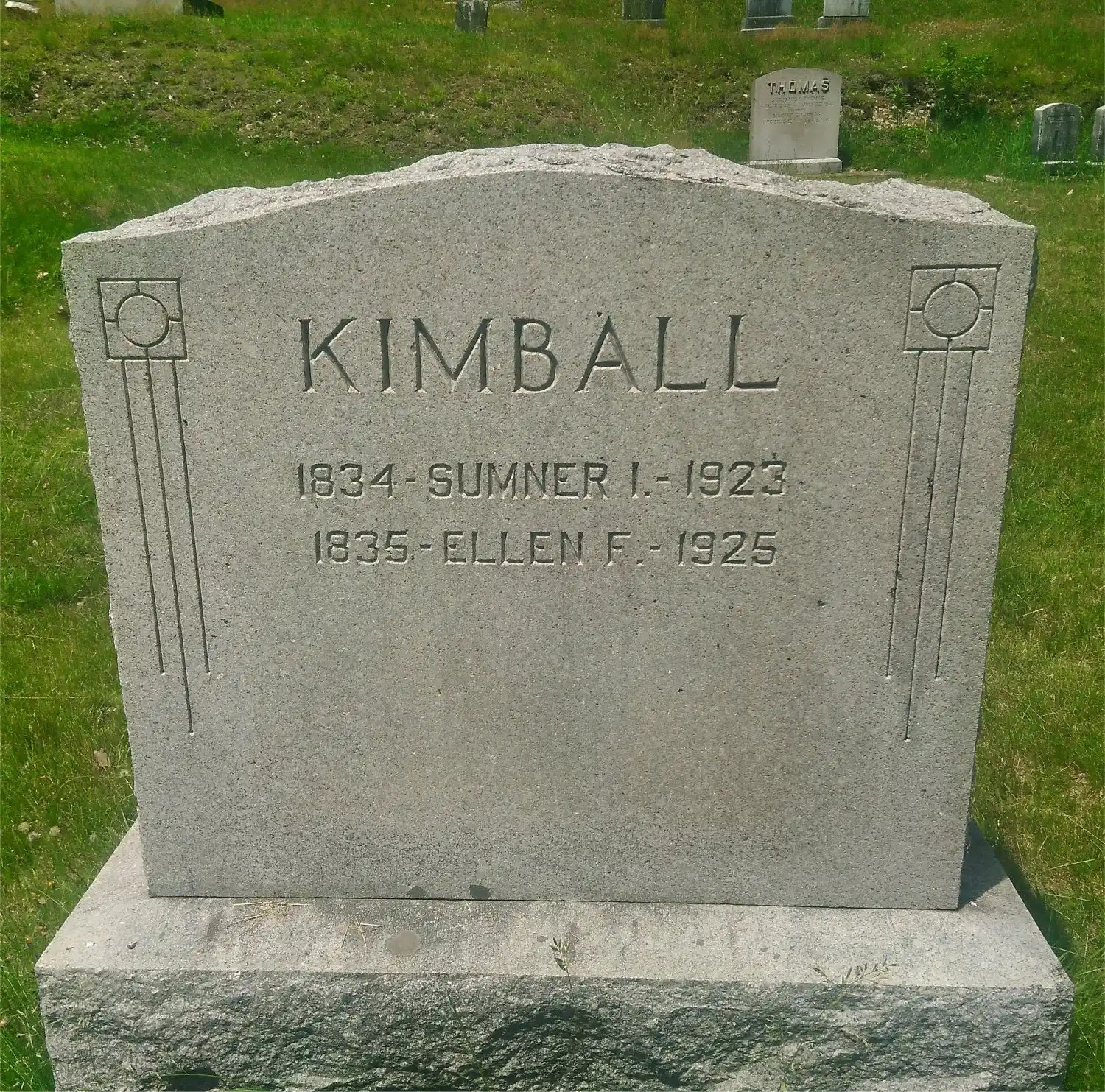
During his remarkable career, Sumner Kimball had more impact on the Coast Guard than any civilian except service founder Alexander Hamilton. After the transition to the new U.S. Coast Guard, Sumner Kimball retired from federal service at the age of 80 years old. He had overseen the Lifesaving Service for 25 years. He began his career with the Treasury Department in 1862 for a remarkable career of 53 years, likely a record for longevity by any Coast Guard-related civilian. For decades, he had husbanded the Revenue Cutter Service and Lifesaving Service and ensured their survival, shaped them into the modern Coast Guard we know today. He passed away in 1923 at his home in Washington, D.C. and was laid to rest in his home state of Maine. He was 88 years old.
-USCG-