MK1 James Fulton climbed onto the bow of the speeding response boat and got ready to jump.
He looked down and thought of the four propellers below, churning through the water of the Severn River, in Annapolis, Maryland.
“The only thing going through my head was not to fall in the water,” he said.
At the helm of the Coast Guard response boat, BM2 Philip Degliomini did his best to hold steady and get Fulton close. What had begun as a standard rescue for a boater thrown overboard had quickly escalated into a high-speed chase. The boater had been pulled to safety by his son on a jet ski, but his unmanned vessel was now spinning wildly out of control.
This is not good at all, Degliomini thought to himself.
While the unfolding scene may have looked like something out of an action movie, it was just another day for the crew of U.S. Coast Guard Station Annapolis.
Degliomini had even been on a crew that stopped a runaway before, though this was his first time driving the intercept. And that incident was far simpler; it was a larger vessel that moved much more slowly.
|
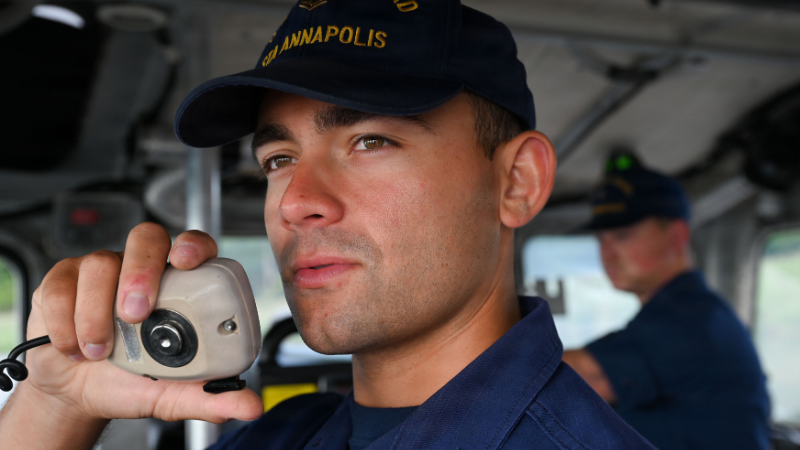 U.S. Coast Guard Petty Officer 2nd Class Philip Degliomini verifies the function of radios aboard a boat at Station Annapolis, Md., Aug. 2, 2025. The crew verified the standardized location and functional use of all equipment aboard multiple boats during a daily, morning routine. (U.S. Coast Guard photo by Petty Officer 1st Class Michael Clark) U.S. Coast Guard Petty Officer 2nd Class Philip Degliomini verifies the function of radios aboard a boat at Station Annapolis, Md., Aug. 2, 2025. The crew verified the standardized location and functional use of all equipment aboard multiple boats during a daily, morning routine. (U.S. Coast Guard photo by Petty Officer 1st Class Michael Clark)
|
This vessel, on the other hand, was out of control, “doing donuts” at over 30 miles per hour.
“It’s basically like a weapon at that point,” recalled Degliomini.
Partners from the Maryland Natural Resources Police (MNRP) and the local fire department had set up a containment zone to keep other boaters out of harm’s way.
Things got more urgent within ten minutes of the Coast Guard crew’s arrival and Degliomini feared the worst. The boat was moving erratically. With other boaters and docks nearby, the runaway missed a nearby pier by only a few yards.
MNRP had been working to jam the runaway’s propellers with a fifty-foot fouling line to no avail. It was time for the Coast Guard crew to give chase.
Luckily, this wasn’t their first rodeo. Coasties may not train to stop runaway boats, but Fulton had jumped aboard two of them before. The key to success is simple, says Fulton, "time it, and jump.”
Degliomini’s three years of experience driving boats “definitely helped” prepare him for this moment. So did his pre-Coast Guard career; he worked as a charter boat mate and at a pontoon rental business on the Jersey Shore and figuratively grew up on the water.
He throttled the engine and began to chase the runaway, doing donuts alongside it for more than thirty minutes. The boat, Fulton explained, kept jumping out of the water, cutting hard to the left, then landing back in the water.
“It wasn’t like a smooth circle,” he explained, “so, finding the opportunity to be able to catch it was really challenging.”
As if the mission weren’t risky enough, Degliomini also had to ensure his crew’s safety—FN Travis Foster and BM3 Joseph Duncan were also aboard—while balancing the small boat’s mechanical limits.
He knows firsthand that hard turns in this kind of boat while fully accelerated can cause the engine to cut out. Which already happened once during the chase.
He also had to be aware of long fouling lines which MNRP had laid out, which could knock out the Coast Guard crew’s engine. So could the crab pots strewn throughout the river.
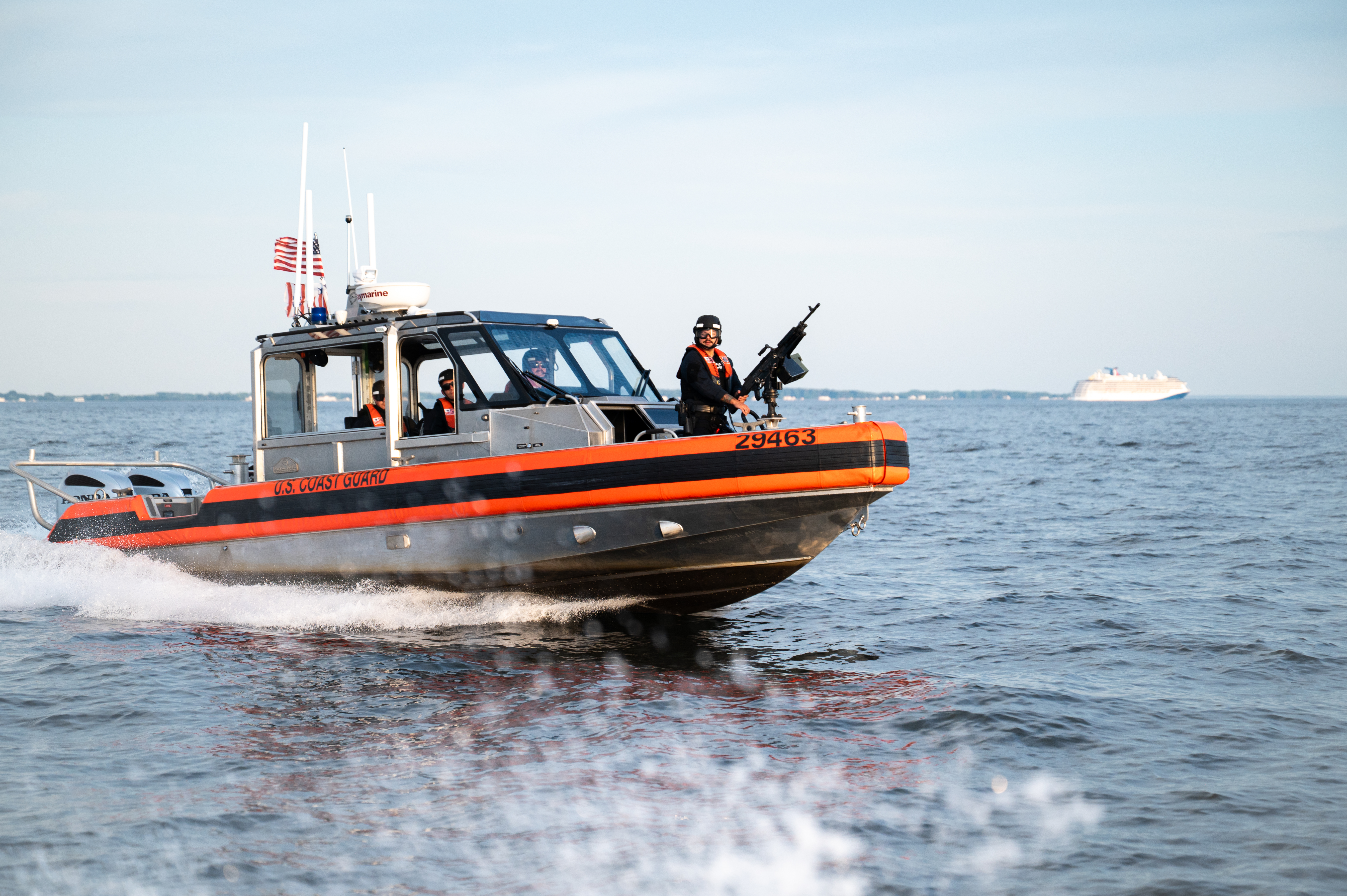 A U.S. Coast Guard response boat-small crew assigned to Coast Guard Station Annapolis, Maryland, performs a sharp turn while preparing for a high-capacity vessel escort in the Chesapeake Bay June 22, 2025. The crew escorted a cruise ship through the bay to deter potential threats, protect passengers and manage nearby vessel traffic. (U.S. Coast Guard photo by Petty Officer 2nd Class Tyler Robertson) A U.S. Coast Guard response boat-small crew assigned to Coast Guard Station Annapolis, Maryland, performs a sharp turn while preparing for a high-capacity vessel escort in the Chesapeake Bay June 22, 2025. The crew escorted a cruise ship through the bay to deter potential threats, protect passengers and manage nearby vessel traffic. (U.S. Coast Guard photo by Petty Officer 2nd Class Tyler Robertson) |
Then came their moment.
One of the MNRP’s lines snagged a propeller on the runaway. Its speed slowed to about 29 miles per hour. Degliomini told the crew to strap in and hang on. He felt his heart pounding as he watched Fulton put on his helmet and steady himself on the bow.
Degliomini’s mind raced. What if he misses? How am I going to stop this boat? If Fulton fell in the water, Degliomini would have only five or ten seconds at most to pull his crewmate to safety before he was back in the boats’ paths.
His smartwatch registered his heart rate at 156 beats per minute at that moment. “It was an adrenaline rush for sure,” he says with a chuckle.
But Fulton was certain he could make the jump.
The Coast Guard boat rammed into the runaway, catching it just before a hard turn. Degliomini gave Fulton the sign, screaming “jump,” at the top of his lungs.
Fulton hurtled over the bow.
Landing safely, he quickly brought both the boat’s throttles down to kill the engine—only to realize that the controls had been disconnected during the chase. Fulton would have to cut the engine manually while making sure it didn’t hit another boat or run aground.
He dug through the vessel, desperate to find a solution. Eventually, he placed a kink in the fuel lines to cut off the engine’s supply. The boat sputtered to a halt in a matter of minutes.
Fulton is nonchalant about his Indiana Jones moment. After all, he’s been there before. “We got lucky that me and BM2 already had experience [with runaway boats]," he said. “I don’t know what the outcome would have been [with a less seasoned crew]."
That day on the Severn River is just the latest in a long line of examples of the importance of boating safety.
“This is the result if you don’t wear your kill switch,” Degliomini stressed. Also known as an engine cut-off switch (ECOS), they’re required by law at certain speeds and on certain vessels. They’re designed to prevent runaway boats like this one from harming fellow boaters and running aground.
It’s been a few weeks since that clear June day, and Degliomini remembers every moment vividly. It’s burned into his memory.
“It was probably one of the craziest things I’ll ever do,” says Degliomini.
Looking for your action movie moment? Join the Coast Guard.
-USCG-
Resources: