SANTA CLARA, Calif. – By the time the first fans arrived at Levi's Stadium, Petty Officer 2nd Class Charlie Campanella had already been watching the sky for an hour.
He'd been doing it from an unmarked vehicle tucked into a corner of the parking lot since a temporary flight restriction went into effect over the USA versus Bosnia-Herzegovina FIFA World Cup match. Two hours remained before kickoff, but his work had already begun, his eyes moving between maps and sensor feeds on a laptop showing every aircraft and drone operating around the stadium.
Outside, thousands of fans in red, white and blue streamed through the gates. Families stopped for photos. Vendors hawked scarves and jerseys. Excitement built around a match that would determine whether the United States advanced to the knockout round.
Few gave much thought to the skies above them.
Campanella did.
And he wasn't alone.
Across the stadium, Chief Petty Officer Jason Garrett stood beside a drone interceptor everyone hoped would remain on the ground. Earlier, he'd inspected the aircraft, charged the batteries, and completed a preflight check. Now he waited.
A few miles away, inside a county building converted into an Air Security Operations Center (ASOC), Chief Petty Officer Brennen Coles settled into a room shared with the Federal Bureau of Investigation (FBI), Federal Aviation Administration (FAA), and local law enforcement. Radar, radio-frequency detections, and camera feeds filled the monitors as Coast Guard operators watched the airspace far beyond the stadium.
For the next several hours, while more than 68,000 fans focused on the match below, their job would be to watch everything happening above it.
Building the invisible shield
The July 1 game marked one of the final missions in the largest Counter-Unmanned Aircraft Systems (C-UAS) operation in Coast Guard history.
As drones have gotten cheaper, more capable, and demonstrated their destructive potential in conflicts overseas, protecting the airspace above major public events has become as important as securing the ground below.
More than 70 Coast Guard C-UAS operators deployed across two coasts this summer, supporting World Cup matches in Santa Clara and near Boston, Mass., while also protecting multiple America 250 celebrations.
It was a dramatic expansion for a capability that only a few years earlier consisted of a smaller team safeguarding one-time events, like inaugurations and Super Bowls. Behind that growth was more than $150 million invested by the Coast Guard's Robotics and Autonomous Systems Program Executive Office (RAS-PEO) to rapidly field the sensors, mobile command vehicles, drone interceptors, and communications systems that made the nationwide deployment possible.
“We had nine events in eight cities over 45 days,” Coles said. “The sheer magnitude of what we were trying to do was unprecedented.”
Together with Master Chief Petty Officer Geoffrey Gall, who led the East Coast effort, Coles spent months scouting locations, assembling equipment, training operators, and solving one logistical problem after another.
Many of those operators volunteered after the Coast Guard announced its new Robotics Mission Specialist rating, bringing backgrounds in aviation, law enforcement, engineering, electronics, and even storekeeping.
Campanella was one of them.
A maritime enforcement specialist from Puget Sound, he arrived at training in April expecting to learn how to fly drones, not defend against them.
“I’d say about half of them showed up thinking they were going to be shooting lasers,” Coles said with a laugh.
Instead, they spent 13 weeks learning how to build an invisible shield of sensors, radios, radar, and communications that could detect, identify, and, if necessary, stop unauthorized drones.
Petty Officer 1st Class Coby Sisco, a boarding officer from Sector San Francisco, became a mission commander. Like Coles, he’d been with the Deployable Specialized Forces (DSF), so he brought a cool head under pressure and proven ability to work with small teams and outside agencies.
“But I had no idea about the complexity and networking aspect of it all,” he said.
|
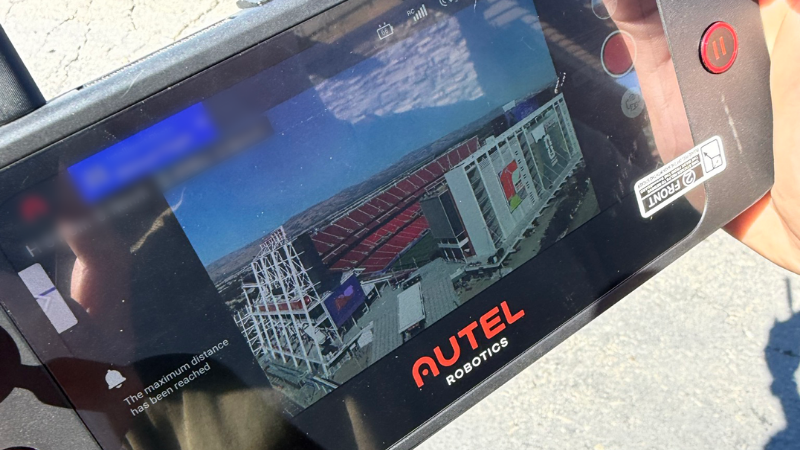 U.S. Coast Guard photo of a UAV controller being operated by a C-UAS team outside of Levi's Stadium, San Clara, CA. U.S. Coast Guard photo of a UAV controller being operated by a C-UAS team outside of Levi's Stadium, San Clara, CA.
Image has been modified to protect sensitive information.
|
No playbook
That morning, long before fans arrived, the team faced its first problem.
One of the sensors wasn't talking to the network.
Coles frowned as he worked through the issue with Watch Commander Petty Officer 3rd Class Brock Whorton.
A former college wrestler and machinery technician, Whorton has become the crew's unofficial troubleshooter, and, teammates say, one of its biggest morale boosters.
"He's very funny and likes to have this persona of just being a regular guy," Garrett said. "But he's so smart."
Whorton started where he always does.
"Does it have power?" he said. "Does it have a network? Does it have internal problems?"
The answer turned out to be simple. Someone had accidentally programmed the sensor for another mission.
Once they fixed that, the gap in coverage disappeared.
"The key thing to doing this job is you have to be adaptive and open to learning," Coles said. "There's not a manual for this."
That uncertainty took getting used to.
As a law enforcement officer, Campanella had built his career around procedures and checklists.
"This is different," he said. "You have to be comfortable solving problems that don't always have a playbook."
Even with his background as an electronics technician, Petty Officer 1st Class Trey Lee remembers struggling initially.
"A lot of this gear was rushed to us at the last minute, and we had a lot of issues getting it up and working," he said. "It was kind of like building the plane while you're trying to fly it."
By late morning, he and his teammates had helped load some of this now-familiar equipment into mobile command vehicles.
Campanella climbed into one and headed toward Levi's Stadium.
|
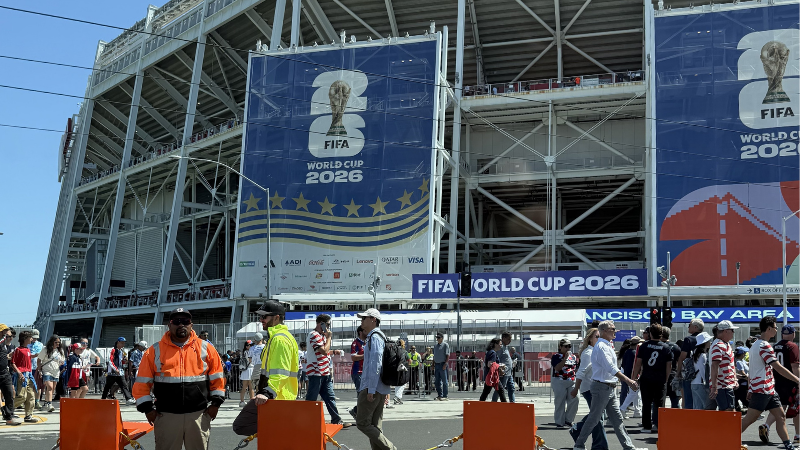 U.S. Coast Guard photo of Levi's Stadium, San Clara, CA. U.S. Coast Guard photo of Levi's Stadium, San Clara, CA.
|
The watch begins
At 2 p.m., the temporary flight restriction went into effect.
Inside the operations center, voice levels lowered and conversations stopped.
“We’ve got our first drone.”
Every head turned.
A local law enforcement official pulled a divider across the room to block conversations drifting in from near the door.
Lee checked the drone’s serial number against the FAA whitelist, where registered operators can seek preapproval to fly near restricted airspace.
“It’s OK.”
Someone exhaled.
The room relaxed.
It would become the rhythm of the afternoon.
A detection.
A few tense moments.
Then back to watching.
Whorton scanned another screen.
Campanella refreshed his display inside the mobile command vehicle. If he saw an issue, he would call Sisco back at the ASOC.
Garrett checked the drone interceptor one more time.
“This job has a weird aspect where the stress goes from very high to nothing,” Whorton said. “That can be an adjustment.”
“When I first started doing this in 2021, every time a drone went up, I felt like I had to move a thousand miles an hour. But as I built experience, I realized you have time to make decisions.”
Santa Clara proved quieter than many other World Cup venues. The stadium’s proximity to San Jose International Airport meant many local drone operators were already familiar with flight restrictions.
Still, Campanella and his teammates continued to monitor their screens.
Garrett texted the operations center for updates.
“You can’t become complacent,” Coles said. “I always think about it this way: If your wife and kids were sitting in that stadium, wouldn’t you want somebody paying attention?”
Garrett understood that better than most.
In May, the Department of Homeland Security had purchased a $1 million Drone Hunter for each of the World Cup stadiums. With his background as an aviation electronics technician (AETC), he’d been given the job of having this interceptor ready to go. In a worst case, he’d use it to capture a drone and bring it back, working with a bomb squad nearby to disable it.
“I constantly rehearse launching it in my head,” he said. “I map out every building, every grove of trees. You don’t want this thing to crash because it’s flying over people.”
Then he added, “I hope I never use it.”
Midway through the match, Campanella drove the mobile command vehicle to the top level of a parking garage.
The higher elevation gave the team's sensors a better view around the stadium.
Moments later, the crowd erupted.
At the end of the first half, the United States had scored.
For a moment, Campanella looked up from his screen.
"It was very cool because I saw the whole thing," he said. "I was celebrating and also realizing I'm working. But it was nice to see who I was protecting and know that I was having an impact."
Four minutes
Not every match stayed that quiet.
Earlier in the tournament, at the end of the Algeria-Jordan game, an alert sounded inside the ASOC.
A drone was headed quickly in the direction of Levi's Stadium.
"It was making a beeline right toward it," Coles said.
The room went quiet.
No one raised their voice.
As mission commander, Sisco immediately began working through what he called the decision tree—confirming the track, checking the FAA whitelist, then evaluating the threat-level of the drone, coordinating with ground officers, and determining the appropriate response.
"No emotion," Sisco said. "You just follow the process."
Outside, Lee climbed into a mobile command vehicle as a Santa Clara police officer drove toward the drone under emergency lights.
"We were trying to get between the drone and the stadium," Lee said.
Inside the ASOC, operators tracked the aircraft while Garrett stood ready beside the interceptor if every other layer failed.
He never needed to launch it.
Sisco kept the suspicious UAS away from the stadium, while letting authorities on the ground know what he was doing.
Within four minutes, officers located the pilot and the drone. The FBI took possession of the aircraft.
The operator wasn't malicious, Lee said. He simply wanted a video of the match.
"But even if there was no intent to harm you could still cause huge amounts of damage,” he said. “It could ground a plane. It could injure somebody."
For Coles, the incident reinforced what months of training had prepared them to do.
"Nobody got excited. Nobody talked fast," he said. "Everybody was able to control themselves and professionally conduct the operation. It was perfect.”
|
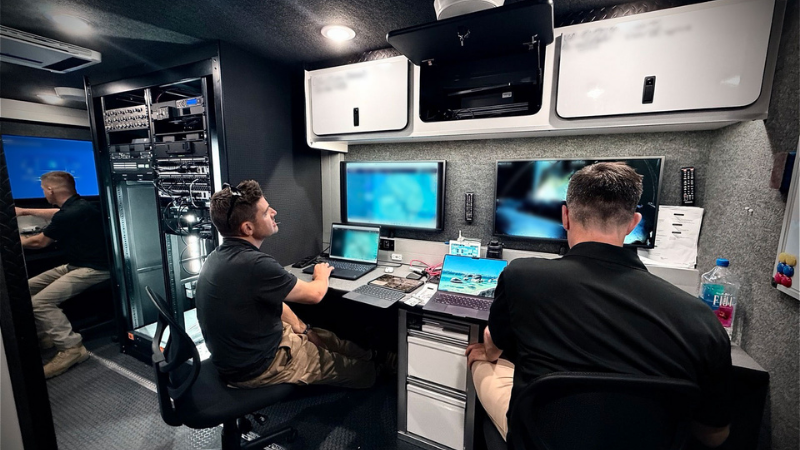 U.S. Coast Guard photo of C-UAS team members in the command vehicle during a security zone enforcement. U.S. Coast Guard photo of C-UAS team members in the command vehicle during a security zone enforcement.
Image has been modified to protect sensitive information.
|
It only takes one
As the final whistle sounded against Bosnia-Herzegovina, cheers echoed through Levi's Stadium.
The Coast Guard stayed on the job.
The temporary flight restriction remained in effect while thousands of fans filtered through parking lots, sidewalks, and train platforms.
Only after the crowds dispersed did the team begin tearing the operation down.
Antennas came off rooftops. Batteries were disconnected. Cables disappeared into cases.
Another Coast Guard team arrived to finish dismantling the site while the World Cup crew headed north. By the next afternoon, many of them would be preparing Counter-UAS operations for Fourth of July America 250 celebrations in San Francisco.
For Coles, events like these and the growing risks posed by drones are exactly why the capability has to keep growing.
"It only takes one time for something to go wrong," he said. "You don't need this capability until you need it."
With the 2028 Olympic Games approaching and drone technology changing almost daily, he believes the Coast Guard can't afford to slow down.
"The worst thing we could do is fall behind."
The team's expertise hadn't gone unnoticed.
At the World Cup, the National Guard asked Coles if the Coast Guard could train them.
After the operation, a representative from the Santa Clara Police Department pulled him aside.
"They said our team was the most professional group they'd worked with," he recalled. “Including the FBI and other federal agencies. Everybody communicated. Everybody worked together. Everyone knew what they were doing.”
Most of the people who attended the World Cup in Santa Clara will never know the Coast Guard was there.
They'll remember the goal 45 seconds into the match.
The roar of the crowd on a summer afternoon.
The fact that the Americans won.
Twenty-four hours later, there was little evidence the Coast Guard had been there either.
Which, Coles says, is exactly the point.
"This is a very thankless job," he said. "Nobody knows we're doing it. And nobody should."
-USCG-