On January 5, 1943, a Lockheed Electra aircraft crashed in the mountains of southeastern Alaska. The plane was travelling from Seattle, Washington, to Annette Island, Alaska, and carried six people. Most were from the Morrison-Knudsen Construction Company and the Civil Aeronautics Administration. A large search effort was initiated on land and sea. Rescuers battled challenging weather and after three weeks without a sighting, called off the search.
All six members on board the Electra survived the crash. Stranded on a snowy mountain, their numbers dwindled down to four over several weeks. Eventually, on February 3, 1943, two of the survivors were able to hike to the shore and signal a Coast Guard vessel. A ground party was quickly assembled to rescue the remaining crash survivors. Twenty Coast Guardsmen from Ketchikan were transported by cutter to a nearby shoreline and began their hike to the survivors. Despite being well-equipped and supported by aircraft, they were overcome by the rugged terrain, armpit-deep snow and frigid weather. The group required resupply by air and a second ground party to complete the rescue on February 7th.
|
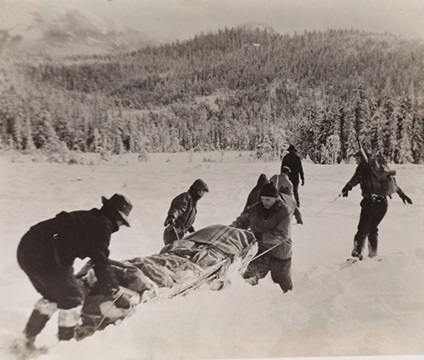 Coast Guard Chief Warrant Officer Arthur Hook (Left) stabilizes a sled carrying a survivor of the 1943 Electra plane crash. (National Archives) Coast Guard Chief Warrant Officer Arthur Hook (Left) stabilizes a sled carrying a survivor of the 1943 Electra plane crash. (National Archives)
|
The leader of the first rescue team, Chief Warrant Officer Arthur H. Hook, knew there had to be a better way to complete rescues in the region. A native of Bellingham, Washington, Hook was accustomed to adventure. He had been a deep-sea diver since 1920 and when he joined the Coast Guard in 1942, his personal 45-foot dive tender boat was also brought into government service.
CWO Hook wasted little time after returning from the Electra crash mission. He crafted a plan to train and employ Coast Guardsmen as parachutists for inland rescues. In March 1943, gaining approval of Captain Frederick A. Zeusler (Captain of the Port for the Territory of Alaska), Hook contacted the U.S. Forest Service (USFS) for assistance.
Up to this time in history Parachute Rescue (Pararescue) was not a proven mission. A small number of attempts were made during World War II to develop the practice. Doctor Leo Paul Martin of the U.S. Army Medical Corps completed USFS “Smokejumper” parachute training in 1940; however, he was later killed in a plane crash in October 1942. Modern day U.S. Air Force Pararescue Jumpers (PJ’s) and Combat Rescue Officers (CRO’s) trace their history back to the rescue of Flight #12420 in Burma on August 2, 1943. The brave medical personnel that parachuted into the Burmese jungle were untrained in the tactics. Only after that rescue would U.S. Army Air Forces formally organize a pararescue unit in that theater. In September 1943, an officer from the U.S. Army Air Corps Second Air Force contacted the USFS about training pararescue personnel. They would begin training in November 1943.
To CWO Hook’s relief, the USFS agreed to train his team at their facility at Seeley Lake, Montana. At this facility, the USFS trained members for its Fire Control Parachute Project better known as “Smokejumpers.” Hook would take nine men with him from Ketchikan, and they arrived at the training camp on July 28, 1943. The USFS agreed to pay for their training in exchange for the ability to use the Coast Guardsmen to fight wildfires during their stay.
|
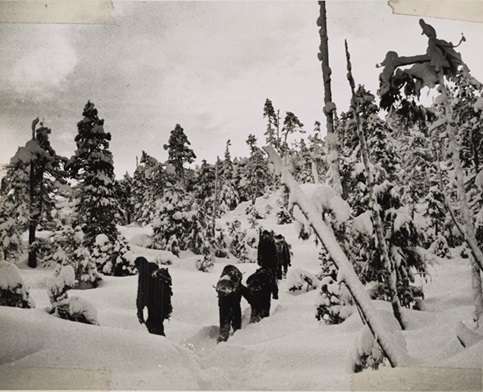 Members of the Coast Guard pararescue unit traversing harsh Alaskan terrain. (National Archives) Members of the Coast Guard pararescue unit traversing harsh Alaskan terrain. (National Archives)
|
The ten men completed the same course of instruction as the USFS and Civilian Public Service (CPS) students with only minor modifications. During the standard course, the six-day ground phase consisted of physical conditioning on an obstacle course, 25-foot tower jumps, tree “let downs,” tree climbing (for equipment recovery), radio operation, and ground-to-air signaling. Hook’s group received extra ground conditioning compared to the normal course. His men also received training on first aid for stranded personnel, landing in various types of terrain, shore searching, cooking, and parachute packing.
The final phase of the course involved actual jumps from aircraft. Using steerable “Derry-Slotted” parachutes, the men averaged nine jumps each at altitudes between 1,400 and 3,500 feet. They became familiar with the trademark Smokejumper protective suit and football helmet, essential attire for descending through a forest canopy. All the Coast Guardsmen graduated with only two injuries being reported. Additionally, the group helped suppress five wildfires before they departed on September 20, 1943.
|
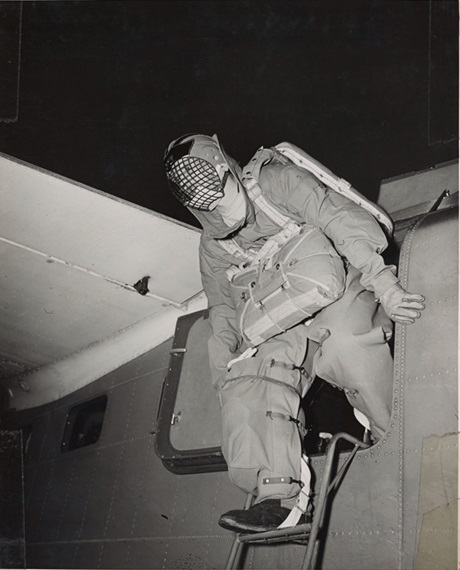 A fully equipped Coast Guard pararescuer demonstrates the proper exit from a Grumman JRF-5G. A fully equipped Coast Guard pararescuer demonstrates the proper exit from a Grumman JRF-5G.
(National Archives)
|
While a full roster of the pararescue unit’s members has not been located, it is believed that the group included Coast Guard Boatswain Mates Marion Nelson and Bryce White, and Bruce Johnstone (a member of the Alaskan Territorial Guard and pioneer with experience as a logger, trapper, prospector, and hunting guide). Six of the ten members are known to have participated in the Electra crash rescue mission.
Little is recorded of the unit’s accomplishments after returning to Alaska, but their capabilities were bolstered in March of 1944 when a Coast Guard Grumman JRF Goose amphibious airplane arrived on Annette Island to form an Air Detachment. Led by LCDR Joseph McCue, the detachment operated tail number V228 and included enlisted pilot Henry “Hank” Pfeiffer in addition to five enlisted maintainers. Members of the pararescue unit would travel to the airfield via boat from Ketchikan. One or two pararescuers would accompany the plane on a typical search mission. They did so in May 1944 in a search for seven Coast Guardsmen missing at sea from CGC Clover. Unfortunately, they only located the capsized boat that had held the men.
|
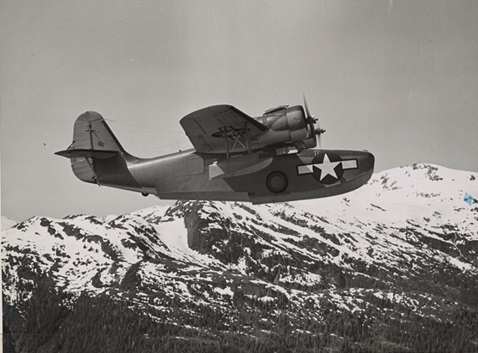 A World War II Coast Guard Grumman JRF-5G in Alaska. (National Archives) A World War II Coast Guard Grumman JRF-5G in Alaska. (National Archives)
|
By the time Arthur Hook transferred as a Lieutenant to Air Station Port Angeles in June 1945, he had rescued nine people and recovered seven bodies. The text of his commendation ribbon citation provides additional insight into the unit’s accomplishments during that period:
As officer in charge of air land and air sea rescue in the Alaskan area, Lieutenant Hook was responsible for organizing those services in that district. With extraordinary fortitude and stamina, Lieutenant Hook time after time led search parties into the mountains of Alaska and successfully rescued lost parties. Of special significance was his 30-day search for a lost plane during the worst winter Alaska had experienced in years, when he succeeded in locating four persons. Lieutenant Hook was instrumental in recovering official records lost in plane crashes at sea and assisted in underwater repair to vessels. In addition, he was responsible for the establishment of coast guard paratroop training which proved highly successful in that area.
|
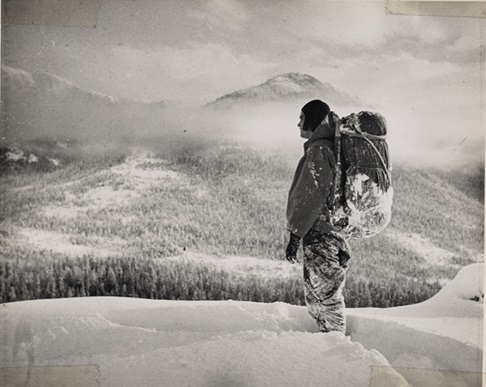 A Coast Guard pararescuer takes in the view from a snowy mountain top in Alaska. (National Archives) A Coast Guard pararescuer takes in the view from a snowy mountain top in Alaska. (National Archives)
|
As the Coast Guard initiated its Air-Sea Rescue Service in late 1944, there was interest in creating additional Parachute Rescue Squads. Based on the planned Air-Land Rescue system in Coast Guard District Thirteen, this squad would likely have gone to Coast Guard Air Station Port Angeles, Washington, which employed Air-Sea and Air-Land Rescue units. The military’s Western Sea Frontier War Diary published a 63-page Air-Land Rescue Manual that provided information on the mission of parachute rescue units as well as how they would fit into the organization. The USFS school in Montana expected to train a second Coast Guard pararescue group in the fall of 1944. This was rescheduled for the spring of 1945 but likely never occurred.
Unofficially, there appears to have been at least one attempted parachute rescue by a Coast Guardsman from Air Station Elizabeth City. Late in World War II, Rear Admiral Bennett Sparks, then an enlisted aircrewman, reportedly parachuted into a swamp to reach a crashed Marine Corps aircraft. Sadly, the pilot was found dead.
Unfortunately, pararescue did not continue as a mission for the Coast Guard after World War Two. It was likely a victim of the large postwar demobilization. Fortunately, the modern U.S. Air Force established a robust pararescue capability in 1947, and it continues to this day.
- USCG -