In a way, CS1 Derek Mazzocoli’s journey to the Coast Guard and the Global Chef Challenge began by chance in a Maryland steakhouse.
The then-student had been working as a busboy when he received a promotion that led to more contact with his colleagues in the kitchen. Soon, Mazzocoli was preparing an array of dishes. He was hooked.
He made the switch to kitchen work and changed his community college major to culinary studies. Mazzocoli had already been interested in the Coast Guard, but a guest lecture from a culinary specialist (CS) sealed the deal. Mazzocoli joined after his graduation.
He is the first to admit he’s not like other chefs—in the Coast Guard and in general.
“I’m the pickiest person you’ll ever meet,” he says with a wry smile. “My staples are chicken nuggets, cheese pizza, grilled cheese, and cereal.”
You wouldn’t know it from the elaborate gourmet dishes in his repertoire. “I like being creative,” he explains. “I like a challenge. I like working with my hands. Cooking happens to be all those things.”
He sees cooking as the ultimate test because his brain craves having “many different things [to] think about at the same time.” Mazzocoli also enjoys expressing himself through food; each meal is “an opportunity to make someone’s day better.”
Being in the Coast Guard has given the accidental chef exposure he would never have found as a civilian. Civilian chefs, he told MyCG, interact far less with diners and guests. That leaves them with fewer opportunities to receive feedback that helps them hone their craft.
“With the Coast Guard, you’ve got this opportunity to interact with people from all walks of life, three times a day,” he said. Mazzocoli loves that he is the first to know if a dish is a hit or if it misses the mark.
Cooking underway has “given [him] thicker skin and a softer heart.” Sea time has made him a more empathetic person, he says. Ultimately, “you don’t want to let [your shipmates] down. You want to cook at your best and learn from other cooks on your ship.”
Mazzocoli’s deployments also created space for him to push himself and refine his talents. From tours aboard 110’ cutters in Alaska to Coast Guard Cutters Bertholf and Healy, he embraced every cooking challenge thrown his way—and even devised new ones.
While aboard the Bertholf, for instance, Mazzocoli challenged himself to cook Beef Wellington—an iconic and complex British dish of juicy beef tenderloin wrapped in crisp puff pastry crust—for the entire 160-person crew. The dish is notoriously hard to get right; it requires exceptional tact and timing.
It took him four days, but Mazzocoli’s Beef Wellington became a hit—so much that he’d make the dish two or three times per patrol.
Over his nine years in uniform, Mazzocoli’s crews have enjoyed a wide range of dishes from Panda Express-style Orange Chicken to pistachio-crusted racks of lamb. He’s proud that both were well-received.
Since his time at sea, Mazzocoli has taken his talents to the Commandant’s Flag Mess, the senior leadership dining facility at Coast Guard Headquarters in Washington, D.C. Today, he serves as Special Command Aide to Vice Commandant Adm. Thomas G. Allan. Mazzocoli is responsible for cooking for Allan and overall upkeep of his home.
As if the task of cooking for the Coast Guard’s top brass weren’t demanding enough, Mazzocoli has taken on new opportunities to push himself. He is an alumnus of the service’s elite, acclaimed Culinary Team and has established himself in the world of competitive cooking.
In 2025, he represented the not only the Coast Guard, but the United States as a whole, at the American Culinary Federation’s national championships in a competition called the World Association of Chefs Society (WACS) Global Chef Challenge. He would compete against eight other countries’ representatives from North, Central, and South America.
Mazzocoli spent two weeks honing his menu, which had five required ingredients. A few days before the competition, he threw his plan out the window and completely changed his menu. With limited time to train on his new slate of recipes, Mazzocoli locked in.
|
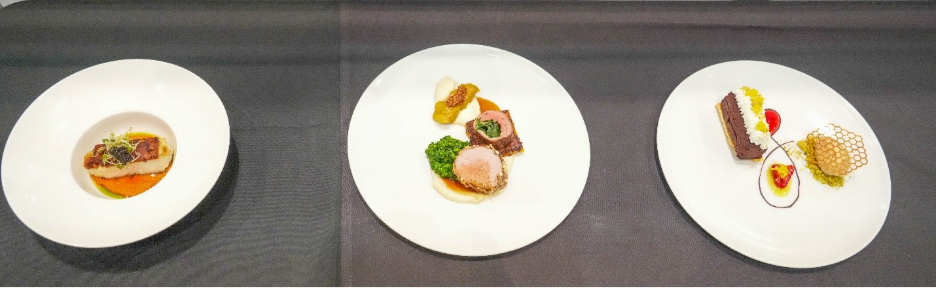 CS1 Derek Mazzocoli’s entry in the WACS Global Chef Challenge at the 2025 American Culinary Federation National Championships. From left to right, brioche-crusted halibut, veal three ways, and a citrus shortbread with Valrhona chocolate cake. (Photo courtesy of the World Association of Chefs Societies) CS1 Derek Mazzocoli’s entry in the WACS Global Chef Challenge at the 2025 American Culinary Federation National Championships. From left to right, brioche-crusted halibut, veal three ways, and a citrus shortbread with Valrhona chocolate cake. (Photo courtesy of the World Association of Chefs Societies)
|
His first course was a brioche-crusted halibut with shrimp mousse, romesco, fried caper salad, and a caviar garnish. For the main: Veal three ways, including veal tenderloin, a veal roulade stuffed with arugula and fontina cheese, and ground veal in a cabbage roll. For dessert, Mazzocoli served citrus shortbread and Valrhona chocolate cake with Chantilly cream, mango coulis, raspberry puree, pistachio crumble, and tea ice cream.
Mazzocoli was proud and surprised to receive the competition’s only gold medal and first place overall. That victory meant that he would represent the United States at the 2026 Global Chef Challenge Finals in Wales—basically the World Cup of cooking. The culinary specialist was only the second military chef in 15 years to qualify. This time, he would bring a Coast Guard sous chef of his choice and a mentor. He and his sous chef would have five hours to prepare four courses using a pre-selected list of ingredients.
The culinary specialist selected his sous chef and went to work, spending weeks curating his menu, refining dishes, and collecting equipment. They were ready to take on the world. They flew to Cardiff, Wales and scoped out their cooking area, assembled ingredients, and steeled themselves for the big day.
When that day came, Mazzocoli would hit unexpected obstacles far beyond his control.
His “equipment fried quickly because of the voltage [in European electrical outlets].” Judges helped him procure the machines he needed, but he was proud to just be able to serve a full menu after losing most of his critical equipment—and the time he needed to get his menu right.
“It was a once-in-a-lifetime experience that I got to share with some amazing people,” Mazzocoli reflected. He is unphased by the fact that the result didn’t go his way. “Sometimes, it’s not about the destination—it’s about the journey to get there.”
Mazzacoli is proud to have competed alongside some of the best chefs in the world and represented the service and his country.
All the while, he has already set his sights on a new challenge: preparing one of his fellow culinary specialists to win the international championships: “I would love to help someone else train for it.”
-USCG-