Sea Air Rotary Wing Evacuation Team (SARWET) was dreamed up by Aviation Electrician Third Class (AE3) Brian Lansburg and me, Bill Thrall, after a 13-year-old girl was lost in a botched rescue attempt sometime in the summer of 1970. Back then, the HH-52 was our rescue helicopter, but it only carried three people: the pilot, co-pilot, and crewman. At that time, only the co-pilot could be dispatched into the water, but only if the pilot authorized it and the co-pilot was willing and able. The crewman couldn’t leave the helicopter because he was the hoist operator.
The young girl was reported missing after hiking along the San Mateo, California, coastline with two or three friends. Supposedly, they walked along the shore below the cliffs during low tide and found a cave and entered it. Sometime later the cave began to fill with water and everyone, except the girl, left the cave and hurried to get above the incoming tide. Sheriff and fire department personnel tried to reach the girl by rappelling down the cliff; however, the cliff kept crumbling, and the rescuers thought a landslide could occur, so they called the Coast Guard.
Air Station San Francisco responded by sending the ready helicopter. It flew down the coast to the location, but all the aircrew could do was verify there was a cave at the bottom of the cliff and that there was no sign of the young girl. The HH-52 flew over to Hamilton Air Force Base, picked up two Air Force paramedics and flew back to San Francisco. There the aircrew traded helos for one full of fuel and flew back down the coast to the cave. The first paramedic jumped out without any authorization or coordination with our pilot; the second paramedic wanted the helicopter to get lower to the water. Apparently, the first paramedic jumped way too soon and way too high. Upon hitting the water, the first paramedic’s face mask was ripped off. He was bounced on the bottom and washed into the cave by the ever-increasing wave action. Upon surfacing in the cave, he found it empty—no girl. It was believed the wave that threw him into the cave also washed her out, but her body was never found.
It was my contention that if the Coast Guard had personnel trained to leave the helicopter and perform like a lifeguard, that the girl could have been rescued on the first trip to the cave six hours earlier. So AE3 Lansburg and I began brainstorming and typing up a proposed program that would train Coast Guard personnel to safely and competently leave a helicopter. In addition, we developed a questionnaire for pilots, crewman, and others that asked questions like: Would you dispatch a person to rescue outside of the helicopter? Would you volunteer for such a program? Would you be willing to leave the helicopter? Do you see a need or any value for such a program? As I remember, these questions took up almost two pages. They were laboriously typed on mimeograph paper using the famous two-finger method and then copies were run-off sufficient to pass-out to officer and enlisted alike. I handed them out and took heat from the unbelievers.
|
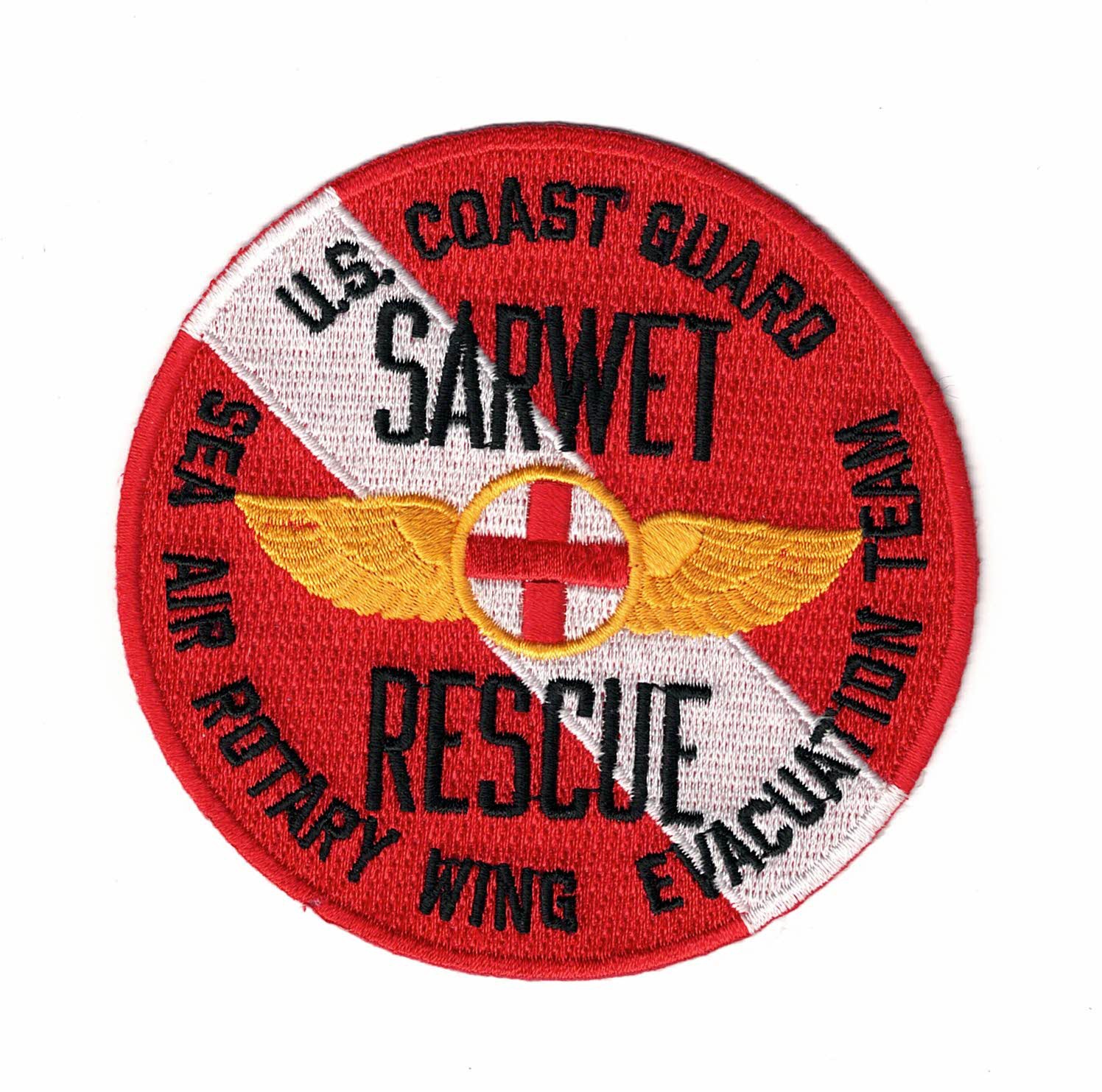 First patch used to designate SARWET. (Courtesy of David Hobson) First patch used to designate SARWET. (Courtesy of David Hobson)
|
It was my thought that armed with these answers (some in favor, some against), I could refine the proposal and then present it to the air station’s commanding officer. However, before I got many questionnaires returned, the air station CO called me into his office. With CDR John Steinbacher present, he berated me and threatened me with a court martial for mutiny and sedition because I didn’t first get his approval to pass the questionnaire around. So, I went around the base and collected the questionnaires from everybody except CDR Steinbacher who said I couldn’t have it back.
I felt SARWET died that day and I was lucky not to be locked up. Several months later, CAPT Charles Larkin took command of the air station. About two weeks later, I was called to CAPT Larkin’s office. CDR Steinbacher stood behind the captain’s desk, and the captain was sitting at his desk. There, in the middle of the desk, was the infamous questionnaire and proposal I had left with Steinbacher. The captain asked if I had written it. I looked at the paper; I looked at him; and I looked at the commander and thought, “This is it. I’m going to the brig! CDR Steinbacher has done me in!” I answered, “Yes Sir, I wrote it.”
|
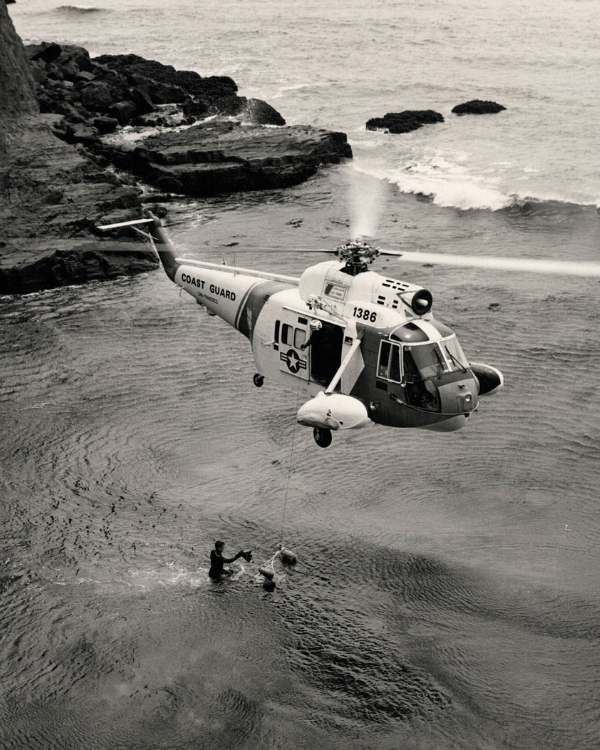 An HH-52 hovers over a SARWET member during training operations on the Northern California coast. (Courtesy of David Hobson) An HH-52 hovers over a SARWET member during training operations on the Northern California coast. (Courtesy of David Hobson)
|
Next, CAPT Larkin wanted to know if I could train the men who volunteered. I said I could. He wanted to know what the equipment cost would be per person. I said about $100 for wet suits and fins. He wanted to know how long it would take to train someone to jump out of a helicopter and rescue victims. I told him it would vary with each trainee, but somewhere between eight and 12 weeks. After I answered his questions, he said, “I want it. Make it happen.” And so, I wandered back to the maintenance hangar naive as hell.
What could have begun immediately was sabotaged by those in mid-management; personnel who volunteered were assigned to a “check crew” and became unavailable. I couldn’t get the time on training days to train. SARWET seemed doomed.
Months went by, then I was called back to CAPT Larkin’s office. It had been almost six months since he told me he wanted the program, and he wanted to know how it was going and how many people were trained and ready. I told him nothing had been done. No one had been trained. He wanted to know why—didn’t I understand he wanted it? And I told him the problem: he was a captain while I was just a petty officer second class and I couldn’t order anyone to support my efforts. It was then that he paused, stared at me, and (I swear it was like a light bulb came on above his head) he said, “Fine. Go back to the hangar. I’ll handle it.”
As I passed the outside window of his office, I could see him on the phone, speaking very animatedly. When I got to the hangar, there was a whole string of officers and chiefs standing outside. I was asked (I believe by Operations Officer CDR Eugene Bauman or CDR Edmund Cope), “Who do you want? When do you want them? And how long do you need them?” That cooperation allowed SARWET to begin. That’s not to say there still weren’t chiefs and others who said repeatedly that it wouldn’t work, but they no longer kept volunteers from training. And no one interfered with me when I took personnel to train. I’d like to think it was our dedicated, no-nonsense training regimen that convinced some of them that I could make SARWET a reality and that it could work—that it might save lives.
From there, my volunteers and I used every training day to train. We used the pool at my former boot camp at the old Training Center Alameda. We ran and did calisthenics at the air station. The sickbay and corpsmen arranged lectures on first aid and treating shock. Aviation Survivalman Second Class Dave Hobson became a very valuable member, designing special SARWET equipment, helping to improve the training program, and training the men when I left for Officer Candidate School (OCS). Operations Officer (CDR Bauman) and helicopter pilots arranged for us to get plenty of helicopter jump time.
LCDR Chester “Sam” Wawrznsky became our public relations champion. He arranged for more training with the U.S. Air Force. He was instrumental in getting the SARWET team TV coverage and media coverage, including several articles in Flight Lines magazine. At one point, the commander wanted us to learn to jump from C-130s, and we were willing to do it!
|
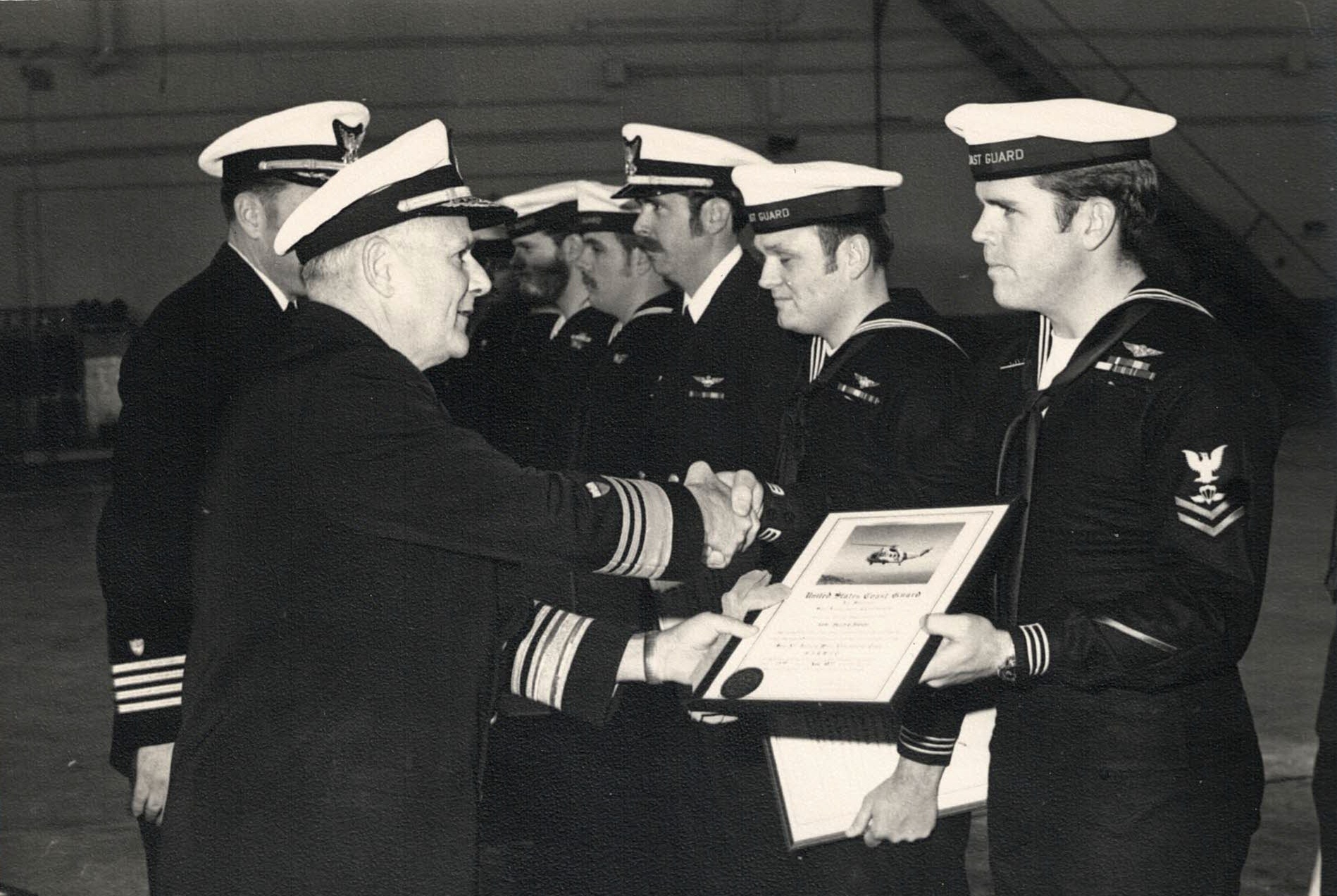 RADM Mark Whalen and CAPT Charles Larkin present SARWET members with the first SARWET designations. (Courtesy of David Hobson) RADM Mark Whalen and CAPT Charles Larkin present SARWET members with the first SARWET designations. (Courtesy of David Hobson)
|
Those were great days. Some of the volunteers had to quit. They weren’t strong enough swimmers. Some had back problems. Others thought SARWET would get them out of work and into something easy. SARWET was anything but easy. If the volunteers made it through the pool days, we would go to the coast and take turns swimming through the surf, learning what we could and could not do with a “victim” in tow. We would swim out to a waiting helicopter and get hoisted. Then we’d jump out and swim back to shore. As word got back to the base about how hard training was, others became interested and wanted to do it—they wanted the challenge. Everybody in SARWET voiced the same desire—to work with victims and help them instead of watching helplessly from the helicopter.
It was important that every SARWET member felt confident and secure both jumping from the helo and swimming in rough surf conditions. And, as time progressed, we became confident. We became strong swimmers and confident first aid deliverers. We were SARWET, ready to respond to any situation where a victim could not be hoisted.
After I went to OCS, it was Dave Hobson and the men he trained that successfully ran SARWET and performed the first SARWET rescues. I heard CAPT Larkin, and his successor were able to fund or sponsor SARWET “out of hide” for about four years, between 1972 and 1976.
In the meantime, I graduated from OCS and came back to the station to say goodbye to my co-workers, supervisors, and SARWET buddies. I especially wanted to stop by and say “Thank you and goodbye” to CAPT Larkin. I owed him so much. It was his efforts and fatherly counsel that placed me in OCS. However, it was Dave Hobson that gave me what would prove so valuable years later, a three-ring binder of 8 x 10 glossies of SARWET equipment and training situations and the complete SARWET training curricula, including equipment lists.
In 1972, it was this three-ring binder I tried to give to the Search & Rescue Office at Headquarters. I was told it needed a letter from me to the Commandant. So, the naive and ignorant bureaucrat that I was, I wrote a letter from ENS William J. Thrall to the Commandant of the Coast Guard. No “vias” were addressed, just from me to him, and I carried this to the LCDR manning a desk at Search & Rescue. He politely took the letter and the binder and placed it in the lower left-hand drawer of his desk, where it remained until early 1985.
In 1985, I was again at Headquarters working in the Office of Radio-Navigation Systems when I received a call from someone in the Search & Rescue Office. He wanted to know if I was the same William Thrall who had given them a three-ring binder on SARWET. When I said I was, I was asked to come to their office to discuss it.
|
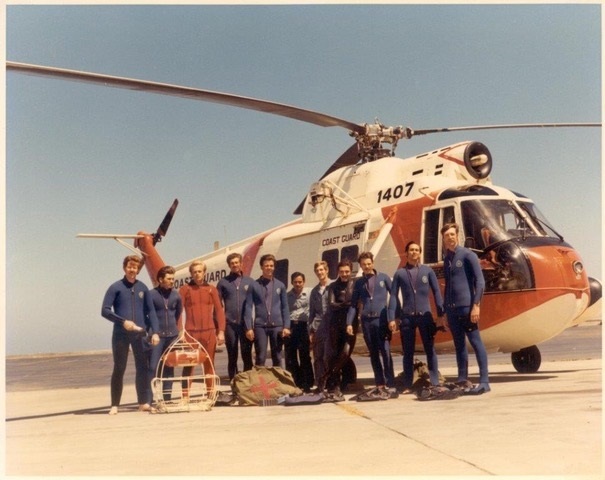 Group photo of the SARWET team posed in front of an HH-52 helicopter at Air Station San Francisco. (Courtesy of Butch Flythe) Group photo of the SARWET team posed in front of an HH-52 helicopter at Air Station San Francisco. (Courtesy of Butch Flythe)
|
The men who questioned me about SARWET that day seemed very interested and excited. Before I left their office, I was asked if I would mind appearing before Congress that weekend. They intended to submit SARWET to Congress as a new tool to enhance SAR.
I was never called, but the concept of SARWET was approved and the Rescue Swimmer Program was born. Again, Dave Hobson was in the right place at the right time and participated in the early years of training and developing men and women to deploy from helicopters.
Me? As much as I tried, I wasn’t in a position to do anything more with SARWET or the Rescue Swimmer Program other than watch enviously from the sidelines.
As I understand it, today the Rescue Swimmer Program is directly responsible for saving hundreds of lives annually and millions of dollars in property. It seems that every week there’s a new clip of a rescue swimmer in action, saving someone. Watching them, I envy them. I’d like to be back, training and rescuing. Oh well.
-USCG-