Last week, the Coast Guard's Helicopter Interdiction Squadron (HITRON) and the crew of Coast Guard Cutter Stone received a national award for an operation that began with a single boat on a screen — and ended with four drug-smuggling vessels stopped in about 15 minutes.
During the presentation of the Maritime Interdiction Award to these units at a ceremony in the Executive Office Building, on Thursday, the White House Office of National Drug Control Policy commended them for pulling off this unprecedented feat which netted nearly 5,000 kilograms of cocaine and eight smugglers.
|
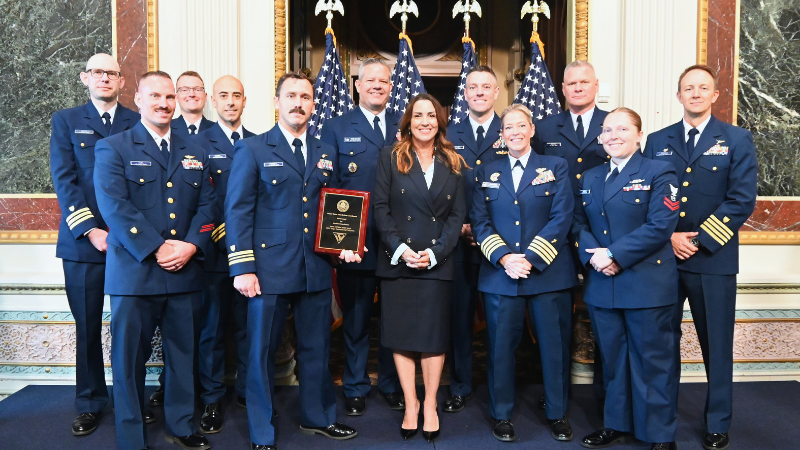 Members from the Coast Guard Cutter Stone and HITRON crews receive the Maritime Interdiction of the Year Award from the White House Office of National Drug Control Policy in Washington, DC on August 27, 2026. The units were recognized for interdicting four go-fast vessels carrying 4,936 kilograms of cocaine in 15 minutes in February 2026. From left to right: CDR Andrew Weiss, STONE XO; AMT2 Ryan Teal, Precision Marksman-Aviation; BM1 Sam Darden, Boarding Officer; LCDR Jamel Chokr, Pilot; LCDR Adam Ownbey, Pilot; ADM Thomas Allen, Vice Commandant; Sara Carter, Director ONDCP; LCDR Steven Naylor, former STONE OPS; CAPT Jennifer Bowden, Chaplain; RDML Jonathan Carter, former CO STONE; OS2 Madison Mifsud, CIC watchstander; CAPT Kent Reinhold, CO HITRON. Members from the Coast Guard Cutter Stone and HITRON crews receive the Maritime Interdiction of the Year Award from the White House Office of National Drug Control Policy in Washington, DC on August 27, 2026. The units were recognized for interdicting four go-fast vessels carrying 4,936 kilograms of cocaine in 15 minutes in February 2026. From left to right: CDR Andrew Weiss, STONE XO; AMT2 Ryan Teal, Precision Marksman-Aviation; BM1 Sam Darden, Boarding Officer; LCDR Jamel Chokr, Pilot; LCDR Adam Ownbey, Pilot; ADM Thomas Allen, Vice Commandant; Sara Carter, Director ONDCP; LCDR Steven Naylor, former STONE OPS; CAPT Jennifer Bowden, Chaplain; RDML Jonathan Carter, former CO STONE; OS2 Madison Mifsud, CIC watchstander; CAPT Kent Reinhold, CO HITRON.
|
Here’s the story of how it happened.
It was just before sunset on Feb. 19, 2025, and the sea was calm and flat in the Eastern Pacific some 110 miles south of the Galapagos Islands.
Lt. Cmdr. Steven Naylor was sitting in the command information center (CIC) aboard the Coast Guard Cutter Stone when something on the screen caught his eye. As the cutter's ScanEagle unmanned aircraft made a turn, a white line showed up in the water.
Suspicious, he asked the operator to take another look. Sure enough, it was a go-fast boat.
Naylor quickly alerted Stone’s Captain at the time, now Rear Adm. Jonathan Carter, up on the bridge. Carter did what he normally did when a target of interest appeared. He called the HITRON and a small-boat crew into the CIC.
He’d barely begun his briefing, however, when the ScanEagle panned the area, and another boat appeared on the screen behind him.
“Wait,” someone said.
As they called in a second crew, another boat appeared.
And then another.
This time, there was no mistaking what they were looking at. The ScanEagle zoomed in on four nearly identical go-fast boats traveling together in a loose diamond formation, black packets visible on board.
The CIC erupted.
“This was my fifth ship and Rear Adm. Carter's sixth ship,” Naylor said, “and neither of us had ever seen more than two go-fasts at once.”
The challenge was figuring out how to stop them with the equipment they had. Four separate boarding teams would be needed, but the Stone only had three boats.
The CIC quickly filled with law enforcement personnel as the crew worked through logistics. Ultimately, they decided to have two boarding teams double up on one of the small boats.
Carter's primary concern was safety. “Everyone was excited, but as commanding officer, I had to weigh the risks,” he said. “I didn’t want to get anyone hurt.”
They came up with a plan Carter dubbed Operation Shoot and Move. The helicopter would work from the back of the group, disabling the boats one at a time while small boats moved in behind them to put boarding teams aboard.
It was an aggressive plan for an unusual situation, and before the helicopter took off, Carter made one thing clear.
“I told them, if they could get one boat, I’d consider it a win,” he said. “Don’t do anything crazy.”
One of the pilots, Lt. Cmdr. Jamel Chokr, remembers how the HITRON crew locked eyes at that moment.
“It was like, ‘Roger that, Captain,’ he said, “but there was no way we weren’t going after all four of them.”
|
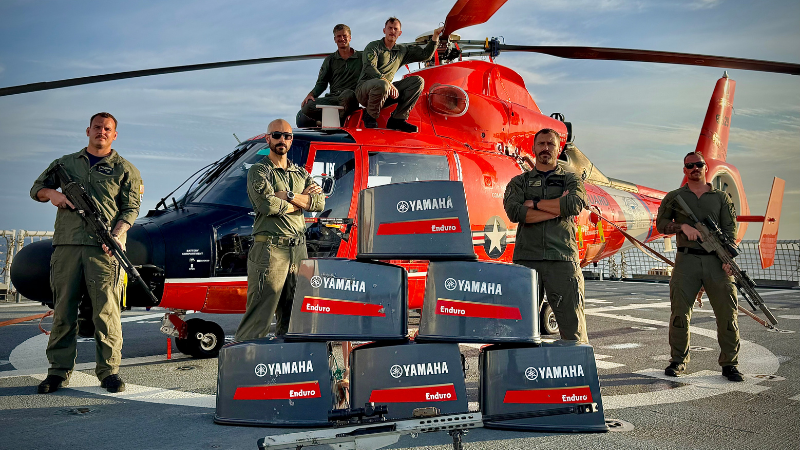 The HITRON crew on the Coast Guard Cutter Stone posing with the motors they disabled during the February 19, 2025, interdiction that stopped four go-fast vessels carrying nearly 5,000 kilograms of cocaine in the Eastern Pacific. From left to right: AMT2 Ryan Teal, LCDR Jamel Chokr, AMT2 Nick Boniface, AET2 Jacob Mounce, LCDR Adam Ownbey, and AMT2 James Gold. The unit later presented this photo and a signed propeller of one of the boats to Rear Adm. Jonathan Carter, who was Stone commander at that time. The HITRON crew on the Coast Guard Cutter Stone posing with the motors they disabled during the February 19, 2025, interdiction that stopped four go-fast vessels carrying nearly 5,000 kilograms of cocaine in the Eastern Pacific. From left to right: AMT2 Ryan Teal, LCDR Jamel Chokr, AMT2 Nick Boniface, AET2 Jacob Mounce, LCDR Adam Ownbey, and AMT2 James Gold. The unit later presented this photo and a signed propeller of one of the boats to Rear Adm. Jonathan Carter, who was Stone commander at that time.
|
Embracing chaos
Their plan lasted about as long as it took the helicopter to reach the boats.
Chokr had envisioned picking off the boat in the rear, then moving up the pack. But when helicopter arrived, the go-fast vessels had stopped in a circle and were jettisoning their drugs. Then they took off.
“They scattered like ants,” he said. “They went in literally every direction.”
Lt. Cmdr. Adam Ownbey, the other pilot, remembers how quickly his crew had to pivot.
“Plan B was you make it work, embrace the chaos,” he said.
The helicopter still worked from the rear of the group, but now they had to constantly adjust. One boat might be closer, but another could be in the helicopter's gun-target line. The pilots had to keep track of the other vessels, the small boats, and the boarding teams moving into position.
“We weren’t trying to move fast, just be efficient,” Ownbey said. “It all went really smoothly from the moment we got in the plane.”
That efficiency came from the three-person helicopter crew doing three different jobs at once.
While Ownbey flew, Chokr coordinated the operation and tracked the other boats. Behind them, Petty Officer 2nd Class Ryan Teal, an aviation maintenance technician, worked the mounted weapon, firing warning shots and, if necessary, disabling rounds.
Teal was on his first deployment as precision marksman, but he already knew that stopping a boat wasn't enough. If the engines weren't completely inoperable, a vessel could get away before the boarding team arrived.
“I had to shoot until all means of propulsion were disabled,” he said, noting that each of the boats had two engines. “It was the first case where I actually had to reload. I think it was either 33 or 36 rounds total.”
As Teal worked to ensure one go-fast vessel was dead in the water, Chokr was looking almost 180 degrees away, already tracking the next target.
The radio crackled nonstop as the helicopter crew coordinated with the Stone and its small boats.
“It was chaos,” Chokr said. “Everybody wanted information from us. Everybody wanted to know what was happening.”
The team disabled three boats, but the fourth was different. When the helicopter approached, that boat’s crew stopped and immediately complied. Unfortunately, a communications mix-up delayed the fourth boarding team.
This meant the helicopter had to stay with the boat.
“We got on the radio and said we need you guys to get here as soon as possible,” Chokr said. “We are running out of fuel.”
When the boarding team finally arrived, the helicopter turned for the cutter and made it back on fumes.
Why it worked
Back aboard Stone, Naylor had been keeping Carter updated as the confirmations, or POSCONs, came in.
One boat.
Two.
Then another.
Somehow, Carter missed the third confirmation. He didn't realize they had gotten all four until Naylor came up to the bridge.
Naylor held up four fingers. Carter did the same.
“Seeing we’d gotten all four was kind of crazy,” Naylor said. “Honestly, none of us thought it would happen.”
Down in the CIC, the crew erupted. So did the people watching from the mess deck where the operation had been playing out on the ship's systems.
“One of the guys said it was like watching an action movie,” Naylor said. “Everybody went nuts.”
For Carter, what made the operation possible started weeks earlier, when Stone and HITRON began learning to work together.
Cutter and helicopter crews have different missions and cultures, and they don’t always get along. But when HITRON, who Carter jokingly referred to as the “B-team,” joined the patrol, they fit right in.
The crews had gone through an intense certification process together and had already worked six cases before the four-boat interdiction.
“We were at the end of a record-breaking patrol,” Naylor said. “We had more cases in 3 ½ months than I had in my four years of counter drugs.”
They also hung out when they weren't working. They played board games at night, did swim calls, and went into port together.
“Forming those bonds before going out on a case helps,” Naylor said.
By the time the four boats appeared on the ScanEagle, they knew each other. They knew how the other crew worked, and they trusted them.
Ownbey, who has enjoyed being afloat since his days as a non-rate on a cutter, called the Stone crew phenomenal.
“I think it was one of the most professional counter-narcotics crews I’ve ever worked with,” he said. “The small boats did a spectacular job.”
For Chokr, that trust mattered when Carter was faced with a situation no one had planned for. Going after all four boats meant deploying multiple boarding teams and giving up some of the overwatch normally provided by helicopter. It was significant risk.
Carter was willing to take it, he said, “because we had built ourselves as a cohesive team with the Stone crew.”
That, combined with the crews’ training and their ability to adapt when the plan fell apart, made the difference.
Carter saw the same thing.
“It would be hard to find a better example of how a Guard cutter and air crew operated together, mitigated the risks, and then executed to perfection,” he said. “The HITRON crew seamlessly integrated into our crew and together we unified to achieve historic results.”
-USCG-