When Ronette Rhoden’s military coworkers at Training Center Yorktown ramped up their workouts in the run-up to the service’s new Physical Readiness Program (PRP), she didn’t expect to be joining them—particularly as a disabled Army veteran with back and knee issues.
But over time, the 48-year-old civilian purchasing agent found herself coming off the sidelines.
“They’d ask me every day to join them for a walk,” she said. “They made it so inclusive that I finally said yes.”
Now, Rhoden is walking regularly, making healthier food choices, and even jogging in place, small steps that mark a big shift.
She isn’t alone.
Across the Coast Guard, many civilians are finding themselves inspired by the PRP. Some are taking formal assessments. Others are joining informal workouts or consciously fitting more physical activity into their day.
It’s a ripple effect that extends well beyond those required to participate.
The PRP, which was formally stood up in January, requires active-duty and reserve members to take part in regular physical training and twice-a-year fitness assessments. It also allots four hours a week of duty time for workouts. More than 37,000 members completed their first Physical Fitness Assessment (PFA) in 2025. Beginning in July, these official fitness test scores will count toward evaluations.
The goal is to reinforce a culture where personal readiness drives mission readiness.
Civilians aren’t required to meet these standards. They’re also limited to three hours of administrative fitness time each week. Yet many are choosing to take part anyway.
For them, one of the program’s most visible effects has been something less formal: fitness is bringing people together.
Building momentum together
Before the first trial PFA last fall, Yorktown Commanding Officer, Capt. Scott Rae, authorized 30-minute walks to help everyone on the base get fit. Rhoden remembers “huffing and puffing,” stopping to catch her breath as coworkers patiently matched her pace along the pier and around the base. She tried the planks and push-ups but ultimately decided she wasn’t ready.
“The great part was I was included without judgment,” she said. “There was no pressure. Everyone knew I wanted to get back into a healthy cycle. They just encouraged me.”
Lt. Cmdr. James Rizzo, who works with Rhoden, said the unit’s focus on momentum over mandates has been by design.
“What I’ve been most proud of isn’t just that people are working out,” he said. “It’s that we’re doing it together. That’s where the motivation comes from.”
Rizzo’s team built a culture around shared effort. They put up a whiteboard tracker where everyone can fill in X’s marking completed workouts. There are regular friendly competitions like treadmill challenges, and group walks along the scenic York River. Junior members help lead workouts, and all participation—whether a full gym session or a quick walk—is celebrated.
The result is a workplace where fitness feels more like a fun group activity than an obligation.
And civilians have taken notice.
“The number of civilians I see in the gym during lunch now is awesome,” Rizzo said. “They’re choosing to be there.”
He also credits leadership.
“It takes people in leadership positions showing it’s okay to step away for 15 minutes and prioritize your health,” he said.
Leading by example
At Coast Guard Headquarters in Washington, D.C., Communications Director Jennifer Plozai has helped spark similar momentum among members of her team.
Last year, she joined a handful of them in taking the first PFA. “We did the push-ups, planks, and running,” she said. “It became something we could do as a group.”
That shared experience has led to new goals, including perhaps tackling a team endurance race in the future.
Plozai acknowledges she didn’t always work out regularly. That changed in her mid-30s, when an instructor in a leadership program told her: “You need to sweat every day. You need to show up for your people ready to work.”
She took that to heart, eventually embracing running, Orange Theory group fitness, and even endurance events like Tough Mudders.
“You never know what situation you’re going to find yourself in,” she said. “So, I think it makes sense to do as much as we can to make sure we’re in good health. We’re in a stressful office, so people need to find the time for that.”
The enthusiasm Plozai helped foster isn’t confined to her team.
|
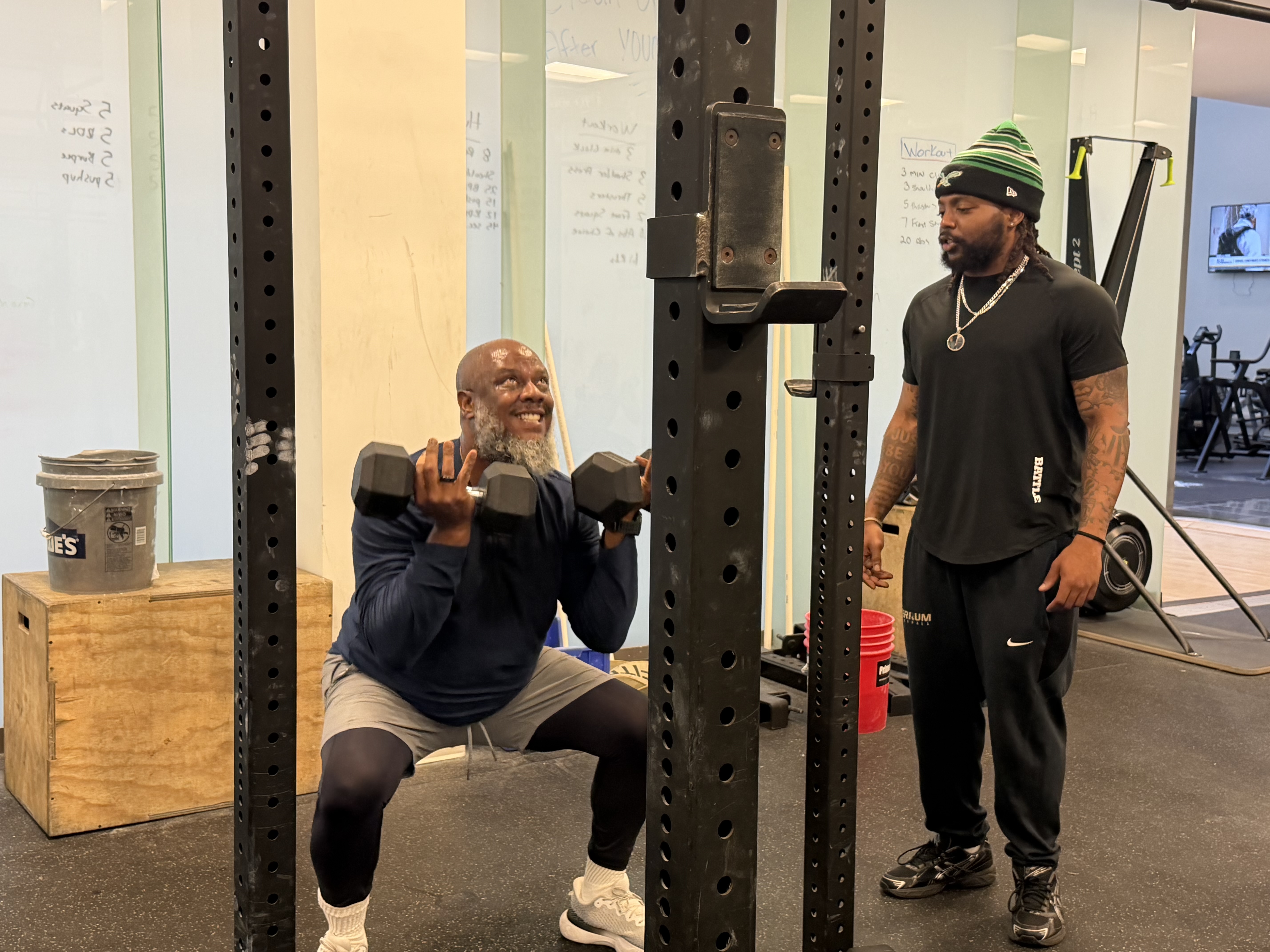 Fitness Center Manager Kai Bowers coaches Coast Guard civilian Phillip Small through squats during a 6:30 a.m. group workout with military members in Washington, DC in June 2026. Small, a division chief at Headquarters, is one of a number of civilians who has been inspired by the Coast Guard’s Physical Readiness Program (PRP). U.S. Coast Guard photo by Kathy Murray Fitness Center Manager Kai Bowers coaches Coast Guard civilian Phillip Small through squats during a 6:30 a.m. group workout with military members in Washington, DC in June 2026. Small, a division chief at Headquarters, is one of a number of civilians who has been inspired by the Coast Guard’s Physical Readiness Program (PRP). U.S. Coast Guard photo by Kathy Murray
|
More than a workout
The same energy is apparent across the road at the Headquarters Fitness Center, where Manager Kai Bowers has watched interest grow since the PRP was introduced.
“Over the last few months, I’ve been working with units preparing for the PFA, and I’ve seen a huge change in civilians getting into it, as well,” Bowers said.
Many start by simply watching what the military members are doing.
“They’ll ask, “What is this? How can I do it? Can I join?” he said.
Drawing on his background as a collegiate athlete and coach, Bowers works with civilians and military members alike, creating free fitness plans tailored to individual goals, schedules, and abilities.
“If you tell me, you can only have 25 minutes to work out here, I can assess where you are and put together a plan that makes you sweat,” he said. “Or if you want to be part of a team working towards an assessment, I can do that, too. Helping people reach their fitness goals is what I love.”
On a recent Friday morning, a mixed group of civilians and military members pushed through a workout in a corner of the gym Bowers has turned into an informal training area. Music echoed through the space—the theme from “Top Gun” gave way to Rocky’s “Eye of the Tiger”—as participants rotated through stations while Bowers moved among them offering encouragement.
“Last set, last set,” he called out to a man and woman dropping to the floor and springing back to their feet in synchronized burpees. “Don’t quit now.”
Among the group was Charles Moore, 44, a civilian security guard who first showed up in November to prepare for a possible fitness assessment for security personnel.
“My hip is killing me,” he joked between exercises before jumping back into the workout.
Under Bowers’ coaching, Moore has lost 30 pounds and says he is in the best shape he has been in years.
“Some days, I have a love/hate relationship with these workouts,” he says. “There are times I don’t feel like coming. But I know this guy here would trash talk me if I didn’t show.”
He nodded toward Phillip Small, who was sweating through the workout beside him.
Small, a 49-year-old division chief at the Office of Data Analytics, started working with Bowers in January. While not required to take the PFA, he’s committed to supporting the military members in his group. “Every time Kai has them do a plank or row, Charles and I also do it,” he says. “One team, one sound is our motto. We are in this together.”
When the recent government shutdown disrupted normal routines at Headquarters, the workouts took on added significance for Small.
“The camaraderie gave me friendship and an outlet during a stressful time,” he said. “The physical results are what people see externally, but for me the stress relief was often more important.”
Bowers hopes more civilians take advantage of the opportunity.
“I’d like to see this place filled,” he said.
For Tony Russell, a Coast Guard civilian and retired officer, those connections are part of what makes fitness programs successful.
“Throughout my career, I very seldom worked out alone,” he said. “That’s where you build camaraderie and have some of the best professional conversations.”
Now the Executive Director for the Center for Arctic Policy at the Coast Guard Academy, he encourages group fitness and sees leaders as key to sustaining it.
“This is generational,” he said. “It starts with expectations.”
One step at a time
Back in Yorktown, Rhoden is proof of what those expectations, and a little encouragement, can accomplish.
Her progress has been gradual: modified push-ups, short walks, small changes in diet.
“I didn’t turn into Beyoncé overnight,” she said. “But every little bit counts.”
And the benefits have extended beyond her workplace.
“My daughter asked to start walking with me so she can get in better shape, too,” she said. “That’s the best part.”
Now, when coworkers head out for a walk, Rhoden doesn’t hesitate to join them.
“I have more energy,” she said. “I’m moving again.”
For Rhoden and many others, the PRP has become about more than just fitness. Across the Coast Guard, workouts have become a reason to step away from a desk, support a colleague, build friendships, and strengthen teams.
The miles, the push-ups, and planks matter. But so do the people doing them together.
If you’re a civilian who’s interested in working out like your military colleagues, the resources below are a great starting point.
-USCG-
Resources:
Physical Readiness Program SharePoint Events Page (to sign up for fitness webinars)
USCG Workout Plan
USCG Nutrition Plan
In the news:
Train Smart, Eat Smart: Level up with the PRP Webinar Series
Physical Readiness Program officially launches July 1
Coast Guard launches Physical Readiness Program